

Temples Through Laos, Cambodia Tour
Summary
This trip is filled with several renowned temples built for royalty, reverence, and ritual. The Vat Vixoune temple was built for a king and is hundreds of years old. The Wat Xieng Thong temple is among the largest in Luang Prabang and housed the coronation for many Lao Kings. In Wat Tagbat, you’ll witness how the monks do their rounds
Highlights
- On this trip, you’ll get your fill of incredible Cambodian temples starting with the Vat Vixoune. Next is the Wat Xieng Thong temple, the largest in Luang Prabang.
- Floating over the Mekong River, you’ll find the sacred Pak Ou caves. You’ll go on to see the Kuangsi Waterfall and take a dip. The South Gate of Angkor Thom is another breathtaking stop.
- The Bayon, Baphuon, Ta Prohm, and Angkor Wat Temples are all part of this amazing excursion. You’ll wrap up by seeing floating villages on the Tonle Sap Lake. The Banteay Srei and Banteay Samre round things off
What is included in this tour?
Items that are included in the cost of tour price.- Careful selected accommodation and breakfast
- Hotel pick-up and drop-off
- Licensed and trained guides
- Transportation to and from trail head
- All necessary documents and permits for trekking (where applicable)
What is not included in this tour?
Items that are not included in the cost of tour price.- International airfares
- Visa fees
- Airport departure tax
- Rescue charge
- Drinks (cold and alcoholic)
- Expenses of personal nature
- Permit and liaison officer fee (where applicable)
- Lunches and dinners whilst not trekking
Day by day Itinerary
Day 1
Arrival Luang PrabangYour guide and driver will meet you at Luang Prabang and transport you to the hotel. Enjoy some leisure time if time permits. Then, we will visit Vat Vixoune was originally built during the reign of King Wisunarat (or Vixoun, 1501-1520) in 1513 (some suggest 1512) and represents the earliest style, sometimes referred to as Luang Prabang Style I, of Lao temple architecture. This style also includes the sims of Wat That Luang and Wat Mai. Wat Wisunalat is Luang Prabang’s oldest operating temple. As with the sims of most Lao wats, there are multiple roof structures.
In the Style I form, the first and second roofs extend around the entire perimeter of the structure. Except for the sim at Wat Mai, which was embellished by two additional gable roofs and two roofed side galleries, the style evokes simplicity, since the sim employs neither the high peaks of the gable nor the dramatic low sweeping roofs of many of the other sims of Luang Prabang. Located and adjoining Wat Aham to the southeast, it was probably built on the rice fields of the guardian spirits of the city (devata Luang), Pu No and Na No (Phou Nheu and Nha Neu). The sacred Prabang image was housed in the sim from 1513 until it was taken to Vientiane in 1707.
The original highly ornate wooden sim was a spectacular example of Lao craftsmanship at its finest and was one of the most imposing religious structures of old Luang Prabang. It had a double roof with the upper roof raised high above the lower roof. It was over 118 ft. (36m) long and 59 ft. 18m wide); perhaps 4,000 trees were used in its construction. Each of the twelve pillars supporting the roof was almost 100 ft. (30 meters high). There were twenty-one windows with turned wooden balustrades. Louis Delaporte’s engraving of its appearance in the 1860s is included in the series of photographs that follow on this site and shows the unique character of the sim. Most of the partitions of the original building were carved wood, and the exterior, as portrayed in the engraving, made it one of the most beautiful in Luang Prabang. It also housed a major collection of rich religious objects and other ”objets d’art”. Most of the sim and the city were destroyed during the invasion of the Chinese Haw Black Flags marauders in 1887.
The sim was rebuilt between 1896 and 1898, during the reign of King Sakkarin Kamsuk (r. 1894-1903). The style was somewhat similar to the old sim with its numerous massive wooden beams, window placement, and style of the roof. Albeit the major part of the structure was brick and plaster in place of the wood. The window balustrades attempt to capture the flavor of the older turned wooden balustrades of the original sim. The sim today continues its existence as a valuable part of museum religious art with numerous centuries-old Buddha statues in bronze and gilded and unadorned wood, ordination precinct stones and other religious objects.
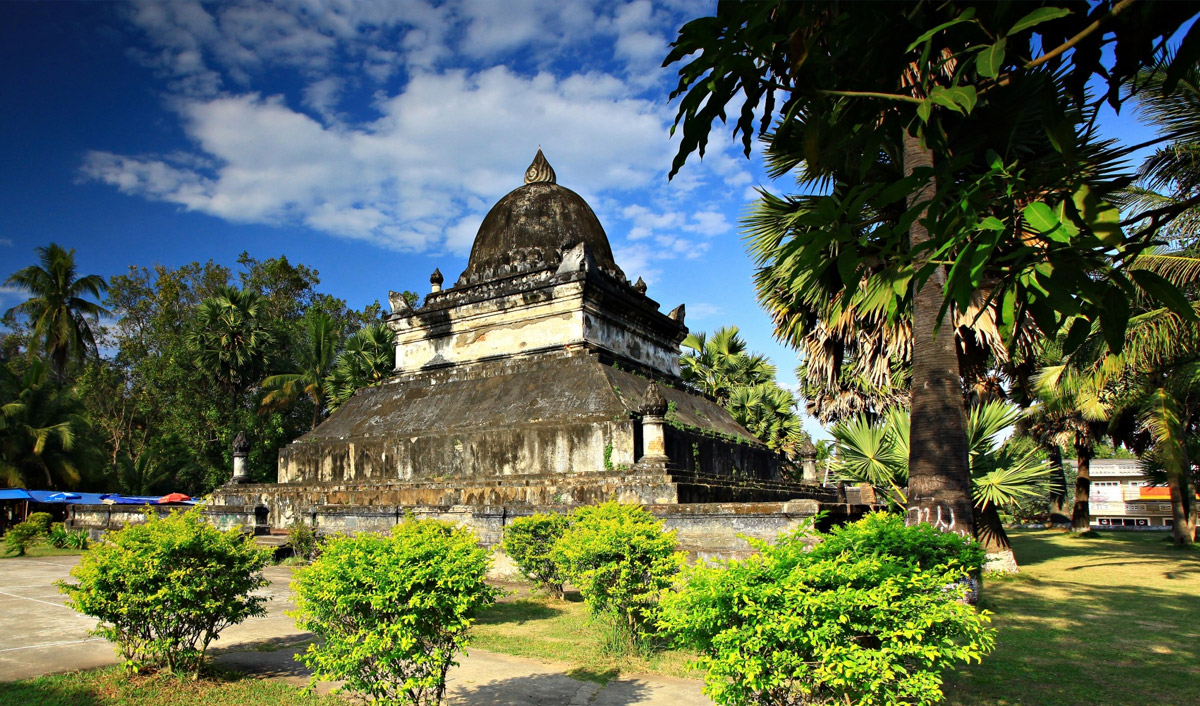
Another important and prominent feature of the wat is it’s unique That Pathoum, or Stupa of the Great Lotus, in the front and northeastern side of the sim. It is known more popularly as That Makmo, the ”Watermelon Stupaï” because of its rounded dome. The dome stylistically reflects a Sinhalese influence and is the only stupa of such a shape in Laos, and perhaps even in Cambodia or Vietnam. Originally erected between 1514 and 1515, it was destroyed during the Haw, Black Flag incursion in 1887. Inside were numerous ancient Buddha images. Many were destroyed; a number are in the National Palace Museum, and some are in the sim itself. Its reconstruction was not seriously undertaken until the late 1920s, over thirty years after the reconstruction of the sim, and was completed in 1932. The stupa sits on a number of different square tiers and has a Lao-Buddhist style Usnisa crown at its top influenced by Thai- Lu architecture and That Makmo, the ”watermelon” stupa, is the nickname given to this building dating from 1503. It is the only monument in Laos to have adopted the rounded shape of Sinhalese stupas – hence its more popular name. Its actual name is in fact That Pathoum, the stupa of the Great Lotus. The stylized flame crowning it symbolizes the illumination of the Buddha. Lightning gutted the stupa in 1914 when precious offerings were revealed here, including gold and crystal statuettes.
We’ll next proceed to Wat Xieng Thong Wat Xieng Thong is one of the largest temples in Luang Prabang. A symbol of great historical importance, its structure has characteristics of 16th-century Lao architecture, with elaborate mosaic patterns, wall carvings, rare Buddhist deities, and a 12-meter-tall funeral carriage.
Wat Xieng Thong once oversaw the coronation of Lao kings – today, it is an important gathering place for significant annual festivities in Luang Prabang. The temple still remains in its original form, with repairs undertaken to the roof, gold leaf gilding and lacquering added to the walls and entrance.
Check out the temple’s sweeping 2-tiered roof and ornate mosaics, including a beautiful ‘tree of life’ glass montage on the rear temple wall. You can also see dharma wheels depicted in gold on the ceiling.
Displayed in the Red Chapel is a rare reclining black Buddha dating back to the reign of King Setthathirat. The Buddha image was showcased in Paris in 1931 before it was returned to the temple in 1964.
The temple grounds also house a Tripitaka library (added in 1880), a drum tower (in 1961) and an ordination hall dating back to 1560. Near the eastern gate of Wat Xieng Thong, you can see a 12-meter-tall funeral carriage that contains urns for members of the royal family.
Wat Xieng Thong is often considered the most beautiful temple of Luang Prabang dating back from the 16th century. You can climb up the Phousy Hill for a panoramic view of the city and the Mekong River.
Check-in is at your hotel in Luang Prabang.
Embark on a trekking and camping adventure in Laos with Adventure Asia.
Hotel options

Victoria Xiengthong Palace - Luang Prabang

Burasari Heritage - Luang Prabang

My Dream Boutique Resort - Luang Prabang

The Apsara hotel - Luang Prabang

3 NAGAS Luang Prabang MGallery By Sofitel
Victoria Xiengthong Palace - Luang Prabang
Located in the heart of Luang Prabang, surrounded by the golden spires of the town’s famous Buddhist temples is Victoria Xiengthong Palace, the last residence of the Laos Royal Family
Day 2
LUANG PRABANG – WAT TAGBAT - PAK OU CAVESStart the day early to reach Wat Tagbat, where you can witness the monks’ rounds. It's a ritual that is truly part of the Lao people’s life and offers a memorable experience and great snapshots. Your guide will explain how to follow the strict customs and rules involved. Then, you may visit the fresh local market. Return to your hotel for breakfast.
After breakfast, your guide and driver will meet you at your hotel and get into a full day of expeditions. You'll see the National Museum and the former Royal King’s Palace, built-in 1904. This French colonial building houses an assortment of religious and royal relics, some of them dating back to the 10th and 11th centuries. Visitors can admire intricately designed mosaics, tiny Buddha statues and interesting portraits displayed among an Italian marble interior that is decorated with traditional Laos and French styles. Continue on to visit Vat Mai with its five-tiered roof and exquisitely carved veranda.
Then, proceed to embark at the local pier of Luang Prabang on a traditional boat. You'll cruise upstream on the Mekong River to visit the sacred Buddha caves. On the way, feel free to stop at the picturesque village of Thin Hong to get a glimpse of daily life. You may also want to visit the Tham Ting and Tham Phoum caves in which you'll find hundreds of Buddha statues.
Lunch at a local restaurant near the caves and return to Luang Prabang by boat. On the way back, stop at Ban Xang Khong, a handmade paper village. Visit Ock Pop Tok, a nice weaving workshop as well. Then drop in the old city for a walk or shop at a Hmong market.
Return to your hotel in Luang Prabang
** Option tour: Dinner at a local house with family members
( Included: 1 bottle of Beer Lao, 1 Tiger Head Water & 1 Coke/person)
Note: This dinner is at a traditional house. You will sit on the floor, take a stroll, or relax in a high chair (per your choice) where'll you get a beautiful view and a great atmosphere with the rice field in front of the family home. Family members will join you for dinner and perhaps talk about the culture, tradition, and lifestyle of the locals.
Day 3
LUANG PRABANG – KUANG SI WATERFALLAfter breakfast, your guide and driver will meet you at the hotel and transfer you to Kuangsi waterfall is near Luang Prabang Ban Long, Laos. It has 3 tiers leading to a 50-meter drop into shallow pools, before flowing downstream. The pools make great swimming holes and you can change into your swimwear at wooden huts close to the waterfalls' entrance.
Surrounded by lush tropical jungle, the pools have cascades of up to 5 meters high. If you don’t fancy a swim, you can relax in the shade and watch others having fun jumping in and out of the water.
There are trails leading to the top of Kuang Si Falls, where you can see the stream feeding into the falls. Wear proper footwear as the trails can get rather slippery, especially during the wet season.
The water is 32 km to the west of Luang Prabang. The way to get there is by taking a short walk through the forest to the waterfall. After enjoying the scenery, take a swim in one of the nearby clear pools.
Below the tiered limestone pools lies the Khmu village Ban Thane. Khmu men are especially good basket weavers and can sometimes be watched crafting.
Lunch is at a local restaurant at Kuangsi. Afterward, you'll drive back to Luang Prabang and enjoy a leisure afternoon.
** Option tour: Playing Petanque
(Included: Snack, 1 bottle of Beer Lao, 1 Tiger Head Water & 1 Coke/person)
Return to your hotel in Luang Prabang.
Day 4
LUANG PRABANG – SIEM REP BY FLIGHTAfter breakfast, your guide and driver will meet you at the hotel and transfer you to the airport for your departure flight to Siem Reap.
Your guide and driver will meet you at Siem Reap airport and transport you to the hotel for check-in. Enjoy a leisurely lunchtime and then continue on to visit Artisans D’Angkor is a good option for purchasing authentic Khmer souvenirs and getting insight into the skilled workmanship of traditional handicrafts in Cambodia. Located along the Stung Thmey Street, this training center was established in 1998 to provide free vocational training in traditional Angkorian art forms to impoverished youths between the ages of 18 and 25.
There are 13 workshops employing over 1,000 local artisans, with all profits from selling handicrafts, textiles, and Homewares going back into funding its training program. One of the most unique features here is that all of the silk paintings are created by young deaf women under the care of Krousar Thmey NGO, an organization that is committed to assisting deprived children in Cambodia.
Entrance to Artisans d’Angkor is free of charge. You can join a complimentary tour of the establishment between 7:30 am and 5:30 pm. Available in English, French, Khmer, Japanese, Chinese, German and Thai, you're guided through the workshops, where you can observe the meticulous techniques of stone and wood carving, lacquering, silver plating, and silk painting.
You can find a wide range of authentic jewelry such as necklaces, bracelets, and earrings as well as silk scarves, handbags, shirts, and dresses. Alternatively, colorful lacquer tableware, ceramic lamps, silk cushion covers, and silk paintings make great gifts for loved ones back home.
You'll next head over to the local market.
Check-in at a hotel in Siem Reap.
Hotel options

Khmer Mansion Residence resort - Siem Reap

Angkor Village Resort - Siem Reap

Victoria Angkor Resort & Spa - Siem Reap

Raffles Grand Hotel d'Angkor - Siem Reap


Khmer Mansion Residence resort - Siem Reap
Khmer Mansion Residence is located in the center of Siem Reap, about 10min walking distance from the famous Pub Street. Rooms are designed and fitted with a private balcony and bathtub. Khmer Mansion Residence offers free use of airport shuttle services and the property also features an indoor pool and free high speed WiFi access is available throughout the property.
Day 5
SIEM REAPAfter breakfast, your guide and driver will meet you at the hotel to begin your visit to the South Gate of Angkor Thom. From the late 12th to early 13th century Angkor Thom is a quadrangle of defensive walls totaling 12 kilometers that once protected the Khmer capital of the same name (Angkor Thom means 'Great City').
Built-in the late 12th and early 13th centuries by King Jayavarman VII, the walls are divided by two axes running north-south and east-west. A gateway lies at the end of each axis, four in total, facing the four cardinal directions. An additional gate, called the 'Gate of Victory', pierces the east wall just north of the 'Gate of the Dead', the east gate along the central axis. The significance of the additional gate is that it provided access to a terrace of the royal palace. As for the other gates, the two axes intersect at the center of the enclosed area where the Bayon temple sits.
The south gate of Angkor Thom is the best preserved. It is approached from outside via a causeway that extends about fifty meters across a moat. On each side of the causeway are railings fashioned with 54 stone figures engaged in the performance of a famous Hindu story: the myth of the Churning of the Ocean. On the left side of the moat, 54 'devas' (guardian gods) pull the head of the snake 'Shesha' while on the right side 54 'asuras' (demon gods) pull the snake's tail in the opposite direction. In this myth, the body of the snake wraps around the central mountain—Mt. Meru—perhaps corresponding here to the Bayon temple at the center of the site. In any case, the myth relates that as the Devas pulled the snake in one direction and the gods pushed in the other, the ocean began to churn and precipitate the elements. By alternating back and forth, the ocean was 'milked', forming the earth and the cosmos anew.
The central tower of the stone gate is capped by three face-towers that face the four directions (the central tower faces both out and in). Below them at the base of the gate are two sets of elephant statues that flank the entrance on both sides. Sitting on each elephant is a figure of the god Indra carrying his usual weapon, the vadra (a lightning bolt). The gate itself is shaped like an upside-down 'U' and is corbels at the top (instead of arches, the builders of Angkor preferred to use corbelling to span distances). It is still possible to see where wooden doors once fitted to the gate through openings in the stone.
There is some debate as to the functionality of Angkor Thom as a whole. If it was a wall intended for defense, it was rather poorly designed, since there is nowhere along the wall of defenders to take refuge from incoming fire or shoot back from a shielded location. This is surprising since Angkor had been sacked in 1177 by Champa invaders, and one can readily imagine that its new King, Jayavarman VII would have been concerned with defense should the invaders' return.
If not intended for defense, the walls may simply have been an additional enclosure around the Bayon temple, more for ceremony than for practical use. As in Southern India, the Angkor rulers built temples surrounded by walls, but usually not with walls as thick and grand as those of Angkor Thom.
Bayon Temple is one of the most famous, popular and beautiful of the structures in the Angkor Wat Archaeological Park. Situated just to the north of Angkor Wat itself, the temple was once at the center of the ancient city of Angkor Thom. It's sometimes called Jayavarman's Temple, in honor of the Khmer king who ordered its construction. It's best known for its many towers with gently smiling faces on each side.
There are some 50 towers around the ruined temple, with over 200 faces showing varying degrees of erosion and wear. Each face is 4 meters high and is facing one of the cardinal directions of the compass. They all have the same serene smile, with eyes closed, representing the all-knowing state of inner peace, and perhaps even a state of Nirvana. There are also many complicated and exquisite bas-reliefs around the temple, with scenes depicting the land and naval warfare, market scenes and even the construction of the temple itself.
Exploring Bayon Temple can be quite tough on the knees as the tour involves lots of narrow corridors, steep flights of stairs and towers. Depending on your pace, it takes about 30-40 minutes to see all of it. As one of the most popular structures in the area and a feature of virtually all tours – whether organized or independent – bits of it can get a little crowded. The ruins are big enough that you can always find somewhere cool and quiet to explore, though.
Bayon is rich in decoration, and the bas-reliefs on the exterior walls of the lower level and on the upper level are outstanding. Those on the southern wall are of scenes from a sea battle between the Khmer and the Cham. However, it's not known if they represent the Cham invasion of AD 1177 or a later victorious battle for the Khmer.
Baphuon - The triple-tiered temple mountain of the Baphuon Temple was the state temple of King Udayadityavarman II. Its pyramid shape represents the mythical Hindu Mount Meru and marks the center of the city that was here before Angkor Thom.
It is immediately to the south of the royal palace of Phimeanakas, and the old walls of the palace can be seen in the shade of the trees north of the temple, making for a pleasant route to walk back towards the main road.
Contemporary sources say that a striking 8-meter-tall tower once stood on top of the temple, probably made of wood gilded with bronze. This is thought to have been demolished in the late-15th century, when the temple was converted from being dedicated to the Hindu God Shiva to Buddha.
A reclining Buddha statue – 9 meters tall and 70 meters long – was added to the second tier on the west-facing side. Sadly, even by this time, it is thought that much of the temple’s structure had already collapsed, due to the fact that it was hastily built on land filled with sand.
You can find the Baphuon Temple slightly northwest of Bayon Temple. Photographing it in the morning will give you the best light on the temple.
Baksei Chamkrong, the Elephant Terrace and the Terrace of the Leper King.Lunch is at a local restaurant. Continue with a visit to Ta Prohm the so-called 'Tomb Raider Temple.' Ta Prohm is cloaked in dappled shadow, its crumbling towers and walls, locked in the slow muscular embrace of vast root systems. Undoubtedly the most atmospheric ruin at Angkor, Ta Prohm should be high on the list of every visitor. Its appeal lies in the fact that, unlike the other monuments of Angkor, it has been swallowed by the jungle, and looks very much the way most of the monuments of Angkor appeared when European explorers first stumbled upon them.
Well, that’s the theory, but in fact, the jungle is pegged back and only the largest trees are left in place, making it manicured rather than raw like Beng Mealea. Still, a visit to Ta Prohm is a unique, other-worldly experience. There is a poetic cycle to this venerable ruin, with humanity first conquering nature to rapidly create, and nature once again conquering humanity to slowly destroy. If Angkor Wat is a testimony to the genius of the ancient Khmers, Ta Prohm reminds us equally of the awesome fecundity and power of the jungle.
Built from 1186 and originally known as Rajavihara (Monastery of the King), Ta Prohm was a Buddhist temple dedicated to the mother of Jayavarman VII. It is one of the few temples in the Angkor region where an inscription provides information about the temple’s dependents and inhabitants. Almost 80,000 people were required to maintain or attend the temple, among them more than 2700 officials and 615 dancers.
Next, you'll go to Angkor Wat temple built by Suryavarman II (r 1112–52) – it is the earthly representation of Mt Meru, the Mt Olympus of the Hindu faith and the abode of ancient gods. The Cambodian god-kings of old each strove to better their ancestors’ structures in size, scale, and symmetry, culminating in what is believed to be the world’s largest religious building.
The temple is the heart and soul of Cambodia and a source of fierce national pride. Unlike the other Angkor monuments, it was never abandoned to the elements and has been in virtually continuous use since it was built.
Symbolically, west is the direction of death, which once led a large number of scholars to conclude that Angkor Wat must have existed primarily as a tomb. This idea was supported by the fact that the magnificent bas-reliefs of the temple were designed to be viewed in an anticlockwise direction, a practice that has precedents in ancient Hindu funeral rites. Vishnu, however, is also frequently associated with the west, and it is now commonly accepted that Angkor Wat most likely served both as a temple and as a mausoleum for Suryavarman II.
Angkor Wat is famous for having more than 3000 beguiling apsaras (heavenly nymphs) carved into its walls. Each of them is unique, and there are 37 different hairstyles for budding stylists to check out. Many of these exquisite apsaras were damaged during efforts to clean the temples with chemicals during the 1980s, but they are being restored by the teams with the German Apsara Conservation Project. Bat urine and droppings also degrade the restored carvings over time.
The sandstone blocks from which Angkor Wat was built were quarried from the holy mountain of Phnom Kulen, more than 50km away, and floated down the Siem Reap River on rafts. The logistics of such an operation are mind-blowing, consuming the labor of thousands. According to inscriptions, the construction of Angkor Wat involved 300,000 workers and 6000 elephants. It was not fully completed.
Note: During the visit of the Bakan tower of Angkor Wat temple, visitors are required to wear proper attire, covering shoulders and knees as this temple is still considered a sacred site (no shorts, miniskirt or short trousers). It will be closed on the Buddhist Sabbath Days, the Buddhist religious days, four days a month in accordance with the Lunar Calendar. (Bakan tower allows only 100 persons once, so visitors have lined up if you wish to climb up).Dinner is at a local restaurant. You may also enjoy an Apsara Dance performance.
Return to your hotel in Siem Reap.
Day 6
SIEM REAPAfter breakfast, your guide will meet you at the hotel and start a boat trip to the floating village on Tonle Sap Lake is the largest freshwater lake in Southeast Asia. Also called Boeung Tonle Sap, it has one of the world’s most vibrant ecosystems. There are different species of wildlife in and around the lake, which helped to sustain and grow the ancient Khmer civilization. It's also famous for its fascinating local communities and their floating villages.
Located in Siem Reap, the massive lake is 250 km in length and 100 km across at its widest point, making it seem like an inland ocean because it is impossible to see the opposite shore from ground level. Surprisingly, it's fairly shallow, with a maximum depth of only 10 meters.
There are several so-called floating villages in and around Tonle Sap Lake and they are all somewhat different. Naturally, many of these villages depend on the lake for the natural resources it provides.
The best time to visit Tonle Sap Lake is during the rainy season (June to October). Water in the Mekong causes the Tonlé Sap River to reverse its flow, which, combined with the extra water from upstream, means that the lake grows to 5 times its size in the dry season. The surrounding plains and forests overflow, creating a diverse and rich ecosystem. It's also when you can arrange for boat trips to Tonle Sap's many floating villages. Trips to the bird sanctuaries are best from December to April. During the dry season, the Tonle Sap Lake drains into the Tonle Sap River, which flows into the Mekong River. The lake becomes very shallow and large boats sit on the bottom. During this time, floating villages move further out onto the middle of the lake. The surrounding forests, dry up and some bird sanctuaries cannot be reached.
Note: High-Level Water Season (August-February) /Low-Level Water Season (March-July).
Lunch is at a local restaurant. You'll then continue with visits to Banteay Srei or Banteay Srey is a 10th-century Cambodian temple dedicated to the Hindu god Shiva. Located in the area of Angkor, it lies near the hill of Phnom Dei is 25 km (16 mi) north-east of the main group of temples that once belonged to the medieval capitals of Yasodharapura and Angkor Thom. Banteay Srei is built largely of red sandstone, a medium that lends itself to the elaborate decorative wall carvings which are still observable today. The buildings themselves are miniature in scale, unusually so when measured by the standards of Angkorian construction. These factors have made the temple extremely popular with tourists, and have led to its being widely praised as a "precious gem", or the "jewel" of Khmer art.
Note: During the visit of Banteay Srei temple – visitors should wear shirts or blouses covering shoulders and arms and long skirts and trousers covering the legs (no miniskirt or short trousers).On the way back from Banteay Srei temple, stop in a village for a fresh coconut drink and to observe how the Cambodian people prepare the sugar palm and do the rice field (depending on the season).
Return to your hotel at Siem Reap.
Day 7
SIEM REAP - DEPARTURE BY FLIGHTAfter breakfast, enjoy your leisure time until your guide and driver meet you at the hotel and transport you to Siem Reap airport for the next destination.
Victoria Xiengthong Palace - Luang Prabang
Located in the heart of Luang Prabang, surrounded by the golden spires of the town’s famous Buddhist temples is Victoria Xiengthong Palace, the last residence of the Laos Royal Family
Victoria Xiengthong Palace - Luang Prabang
Located in the heart of Luang Prabang, surrounded by the golden spires of the town’s famous Buddhist temples is Victoria Xiengthong Palace, the last residence of the Laos Royal Family
Burasari Heritage - Luang Prabang
Burasari Heritage invites you to enjoy a classic Indochinese experience in Luang Prabang, Asia’s most celebrated UNESCO World Heritage city. Located on a tranquil riverside lane, Burasari Heritage blends classic French colonial aesthetics with the warmth and coziness of traditional Lao teakwood houses. Take in gorgeous views from the property’s riverside lounge and deck, or stroll down the historic town’s ancient avenues among glittering temples, exotic markets, and French-style sidewalk cafés. Relax in the spacious handsome suites, appointed with Indochinese decor and local handcrafted textiles that carry you back to another time, where life moves a little slower, where there is time to reflect and regenerate.
My Dream Boutique Resort - Luang Prabang
My Dream Boutique Resort is a truly unique hotel in Luang Prabang.
We offer chic, modern accommodation, while embracing traditional Lao style.


My Dream Boutique Resort - Luang Prabang
My Dream Boutique Resort is a truly unique hotel in Luang Prabang.
We offer chic, modern accommodation, while embracing traditional Lao style.
The Apsara hotel - Luang Prabang
Directly opposite The Apsara, The Apsara Rive Droite offers luxurious comfort set around a pool in lush tropical gardens. All rooms have balconies or terraces where you can relax in privacy, while the hotel boat The Apsarian Queen means you are only moments from the bustle of town.
3 NAGAS Luang Prabang MGallery By Sofitel
Located one the main street of Luang Prabang, 3 Nagas offers an unbeatable location surrounded by temples and local artisans. Located 100 meters away from Mekong River and Nam Khan river. For shoppers, the nearby night market will be perfect. Walk along the main road to find the Royal Palace Museum, mount phousi and the daily night market.
Khmer Mansion Residence resort - Siem Reap
Khmer Mansion Residence is located in the center of Siem Reap, about 10min walking distance from the famous Pub Street. Rooms are designed and fitted with a private balcony and bathtub. Khmer Mansion Residence offers free use of airport shuttle services and the property also features an indoor pool and free high speed WiFi access is available throughout the property.
Angkor Village Resort - Siem Reap
Angkor Village Resort - Siem Reap
Victoria Angkor Resort & Spa - Siem Reap
Victoria Angkor Resort & Spa is a 5* hotel in the heart of Siem Reap that reminds us the wellbeing, elegance and refinement of the French Lifestyle.
Victoria Angkor Resort & Spa - Siem Reap
Victoria Angkor Resort & Spa is a 5* hotel in the heart of Siem Reap that reminds us the wellbeing, elegance and refinement of the French Lifestyle.
Raffles Grand Hotel d'Angkor - Siem Reap
An oasis of tranquillity and a place of great inspiration, the Raffles Grand Hotel d'Angkor is a haven for the well-travelled. A stone's throw from the temple ruins of Angkor and the bustling resort town of Siem Reap, the hotel's luxuriant accommodations, services and facilities offer a unique blend of old-world charm and modern necessities.
Victoria Xiengthong Palace - Luang Prabang
Located in the heart of Luang Prabang, surrounded by the golden spires of the town’s famous Buddhist temples is Victoria Xiengthong Palace, the last residence of the Laos Royal Family
Victoria Xiengthong Palace - Luang Prabang
Located in the heart of Luang Prabang, surrounded by the golden spires of the town’s famous Buddhist temples is Victoria Xiengthong Palace, the last residence of the Laos Royal Family
Burasari Heritage - Luang Prabang
Burasari Heritage invites you to enjoy a classic Indochinese experience in Luang Prabang, Asia’s most celebrated UNESCO World Heritage city. Located on a tranquil riverside lane, Burasari Heritage blends classic French colonial aesthetics with the warmth and coziness of traditional Lao teakwood houses. Take in gorgeous views from the property’s riverside lounge and deck, or stroll down the historic town’s ancient avenues among glittering temples, exotic markets, and French-style sidewalk cafés. Relax in the spacious handsome suites, appointed with Indochinese decor and local handcrafted textiles that carry you back to another time, where life moves a little slower, where there is time to reflect and regenerate.
My Dream Boutique Resort - Luang Prabang
My Dream Boutique Resort is a truly unique hotel in Luang Prabang.
We offer chic, modern accommodation, while embracing traditional Lao style.
My Dream Boutique Resort - Luang Prabang
My Dream Boutique Resort is a truly unique hotel in Luang Prabang.
We offer chic, modern accommodation, while embracing traditional Lao style.
The Apsara hotel - Luang Prabang
Directly opposite The Apsara, The Apsara Rive Droite offers luxurious comfort set around a pool in lush tropical gardens. All rooms have balconies or terraces where you can relax in privacy, while the hotel boat The Apsarian Queen means you are only moments from the bustle of town.


Namtha River Exploration with Homestay
 3
 3 days 2 nights
The Namtha River is the lifeblood of the northwest Lao people and this 3-day adventure takes you on an extended journey through old growth forests and past riverside villages, where you will stay and gain unique insights into the lifestyle and culture of your local hosts. Beginning in Luang Namtha, the voyage ends at a border town between Thailand and Laos.

Namtha Exploration
1 1 dayNamtha River exploring villages and wildlife while taking in the remarkable beauty of the river scenery.

Luang Namtha Cycling Tour 1 day
1 1 day Fairly Easy
Great for cycling buffs short on time but want the full guided experience around the beautiful valley! It is an excellent opportunity to tour large parts of Luang Namtha, visiting several minority communities in the space of one eventful day. You get to witness first-hand the work and technique involved in the creation of traditional minority handcrafts. Visit stupas and monasteries that are of great religious and cultural significance to the local people, with the added bonus of stunning vistas across Luang Namtha.

Northern Laos: Nam Ha Trek to the Thai Border
8 8 DAYS ModerateThis eight-day private journey moves through the least-visited corridor of northern Laos, tracing the Nam Ou River northward before crossing the mountains toward the Mekong and the Thai border. The route begins at Pak Ou, where a limestone cliff above the river confluence has held more than four thousand Buddha images for centuries, and it ends at Huay Xai on the upper Mekong. Between those two points the journey passes through Nong Khiaw, a town set in a valley of forested limestone peaks, then continues upriver by longtail boat to Muang Khua before transferring overland to Oudomxay and on to Luang Namtha. Two full days in Nam Ha National Protected Area form the core of the itinerary, with nights in Khmu and Lahu villages providing sustained contact with communities whose daily lives remain largely shaped by the forest and the land. The pace is deliberate. Each stage of the journey follows a logical geographic arc, moving from the well-known river landscapes of the south toward progressively more remote highland terrain in the north.

2 Days Trekking Through The Jungle Of Nong Khiaw
1 2 days 1 nightThis is an adventure tour packed with diverse activities that begin and end in the World Heritage Site Luang Prabang and takes you to explore Nong Khiaw and Muang Ngoi, both known for their remote and stunning mountainous landscapes set on the Nam Ou River. Enjoy some of the best trekking, kayaking, and long-tail boat rides in the area and experience the Tiger Trail-discovered 100 Waterfall tour and the famous Pak Ou Caves north of Luang Prabang. Overnight in a great mix of ethnic home stays and riverside lodges.

Half Day Luang Prabang Cycling Tour
1 Half dayDiscover parts of the city that are inaccessible by coach or car during a bike tour of Luang Prabang. Exploring by bike allows you to skip the stress of parking and get a more intimate glimpse into Luang Prabang, a UNESCO World Heritage Site. Plus, the short duration of this half-day tour makes it the ideal choice for visitors on a time budget.

Mountain Biking To Kuang Si Waterfall
2 2 days 1 nightWe'll help you choose a great bike in Luang Prabang before setting off on a scenic, 30km paved-road ride along the Mekong River down to the Kuang Si waterfall. The ride last 3-4hours, is medium grade with some hills, and we'll make a stop to explore villages and a Hmong Culture Museum along the way. Kuang Si Waterfall spans a large area through some of the lushest jungle around Luang Prabang. Easy walking trails wind past numerous pools and cascading waterfalls where you can relax and swim . Lunch will be provided at the waterfall. There are a small number of private changing rooms near the waterfall where you can change into your swimsuit. You can also see up close Asiatic bears at the Bear Rescue Centre along the jungle walk to the waterfall. After plenty of recreation time at the waterfall, hop back onto the bikes for a fun downhill ride to the Mekong River, where you'll board a long-tail boat for 1.5-2hour scenic cruise up the Mekong River back to Luang Prabang.

Temples Through Laos, Cambodia Tour
7 7 days 6 nightsThis trip is filled with several renowned temples built for royalty, reverence, and ritual. The Vat Vixoune temple was built for a king and is hundreds of years old. The Wat Xieng Thong temple is among the largest in Luang Prabang and housed the coronation for many Lao Kings. In Wat Tagbat, you’ll witness how the monks do their rounds

Explore Luang Prabang in 4 days
4 4 days 3 nightsEnjoy four days exploring Luang Prabang on your Laos tour with the addition of this four-day extension. Witness the giving of alms to monks first hand in the early morning and observe as they walk the streets to collect their daily food. Visit the lively marketplace and wander to the main streets in Luang Prabang, including the Wat Xient Thong Temple. Cruise the Mekong River and visit the hidden Pak Ou Caves, once a spiritual haven. Spend time visiting weavers and other textile makers in riverside villages and hike to the Kuang Si Waterfall. Enjoy four days exploring northern Laos on this guided Luang Prabang tour.

Cycling, Kayaking & Elephant Riding In Luang Prabang
2 2 days 1 nightMulti activity adventures to get real sound and senses of the ancient capital of Laos, Luang Prabang. You are going to bike, trek and kayak each day of the tour. Every day, we will get you involved in different types of activities at introductory to moderate grade. Some of the day tours may be quite intense. This adventure will surely give an exotic picture of Luang Prabang that you have not known before.
Temples Through Laos, Cambodia Tour
7 7 days 6 nightsThis trip is filled with several renowned temples built for royalty, reverence, and ritual. The Vat Vixoune temple was built for a king and is hundreds of years old. The Wat Xieng Thong temple is among the largest in Luang Prabang and housed the coronation for many Lao Kings. In Wat Tagbat, you’ll witness how the monks do their rounds

Exploring the culture, religion and nature of Laos-Cambodia
7 7 days 6 nightsLaos-Cambodia is filled with cultural, religious and natural attractions and Exploring the culture, religion, and nature of Laos-Cambodia 7-Day tour is the perfect way of exploring these amazing attractions and experiences. You will enjoy the deeply spiritual Baci Ceremony, sacred caves, temples, waterfalls and historical museums. This tour will give you an insight into the life and what Laos-Cambodia offers as a travel destination. You will remember this trip for a long time!

Yunnan Breezes and Laos Trails
14 14 DAYS LeisurelyThis fourteen-day journey connects two distinct worlds by cycle, rail, and river. The first half traces the ancient Tea Horse corridors of Yunnan, riding and walking through Naxi and Bai minority territories, UNESCO market towns, and mountain passes that once carried tea and horses between kingdoms. A high-speed rail crossing then drops the route into northern Laos, where the cycling shifts to river valleys, limestone karsts, and hill-tribe villages little changed by outside commerce. The journey ends in Luang Prabang, a city of temples and quiet streets where the pace slows naturally and the detail repays attention.

Laos–Vietnam Explorer: Highlands to Halong Bay
16 16 DAYS LeisurelyThis sixteen-day journey moves through Laos and Vietnam at a pace that allows for genuine engagement with both landscape and community. Beginning in the UNESCO-listed streets of Luang Prabang, the route travels north through limestone valleys before crossing into Vietnam at a quiet border. The Vietnamese highlands unfold in sequence: Dien Bien Phu, the Pha Din Pass, the plateaus of Moc Chau, the Black Tai communities of Mai Chau, and the primary forest of Cuc Phuong National Park. The trip concludes with a private cruise through Halong Bay, with time to explore caves and pearl-farming waters. Accommodation is selected for character and location, and meals reflect the food culture of each area, including a lunch of buffalo cheese at a social enterprise dairy and a picnic on the Nam Ou River. This journey is for travelers comfortable with physical days and who value the quality of what they encounter.

Northern Heights: Upper Mekong Hill Tribes
12 12 DAYS Fairly EasyThis twelve-day cycling journey moves through the hill country of northern Thailand before crossing into Laos and following the Mekong and Nam Ou river corridors south to Luang Prabang. The route rides through teak forest, limestone karst, and terraced farmland, with frequent encounters with Akha, Hmong, Phu Tai, and Khamu communities whose villages have shaped this landscape for generations. River days on the upper Mekong by longboat and the 100 Waterfalls trek punctuate the riding. The pace is deliberate, allowing time to absorb the transition from Thai highland culture into the quieter provinces of northern Laos before the journey concludes in Luang Prabang.

Laos–Vietnam Explorer: Village Homestays Route
12 12 DAYS Fairly EasyThis twelve-day journey moves overland and by river from the UNESCO-listed streets of Luang Prabang through the forested interior of northern Laos, crosses into Vietnam at a little-used border point, and descends through the ethnic minority highlands of the northwest before reaching Hanoi. The route is divided between cycling, trekking, and a long river passage on the Nam Ou. Each section of the journey brings a distinct change in landscape, culture, and pace. Villages along the way belong to Khmu, Hmong, Tai Dam, and other communities whose daily lives remain largely apart from the tourist trail. The crossing at Dien Bien Phu adds a layer of twentieth-century history to a journey that is otherwise shaped by terrain, river, and forest. This is a demanding route, physically and logistically, best suited to travellers who are comfortable with variable road conditions, remote overnight stops, and long days in the saddle.
Ride the Trail
12 12 DAYS Fairly EasyThis twelve-day journey traces the historic Ho Chi Minh Trail from Hanoi southward through central Vietnam, across the Lao border, and down through the remote provinces of southern Laos before returning to Vietnam and finishing in Ho Chi Minh City. The route connects landscapes that shaped twentieth-century history: imperial citadels and pagodas on the Perfume River, the contested A Shau Valley, the Khe Sanh plateau, and the quiet Lao countryside where the Trail ran deepest and longest. In Laos, the journey moves through Xepon, Saravane, Tad Lo, Sekong, and Attapeu before crossing back over the Truong Son Range into the Central Highlands of Vietnam. The days are physically demanding and the distances are real. What sustains the effort is the quality of what the route reveals: a continuous thread of landscape, memory, and gradual change that no single destination could provide.
Namtha River Exploration with Homestay
3 3 days 2 nightsThe Namtha River is the lifeblood of the northwest Lao people and this 3-day adventure takes you on an extended journey through old growth forests and past riverside villages, where you will stay and gain unique insights into the lifestyle and culture of your local hosts. Beginning in Luang Namtha, the voyage ends at a border town between Thailand and Laos.
Namtha Exploration
1 1 dayNamtha River exploring villages and wildlife while taking in the remarkable beauty of the river scenery.
Luang Namtha Cycling Tour 1 day
1 1 day Fairly EasyGreat for cycling buffs short on time but want the full guided experience around the beautiful valley! It is an excellent opportunity to tour large parts of Luang Namtha, visiting several minority communities in the space of one eventful day. You get to witness first-hand the work and technique involved in the creation of traditional minority handcrafts. Visit stupas and monasteries that are of great religious and cultural significance to the local people, with the added bonus of stunning vistas across Luang Namtha.
Northern Laos: Nam Ha Trek to the Thai Border
8 8 DAYS ModerateThis eight-day private journey moves through the least-visited corridor of northern Laos, tracing the Nam Ou River northward before crossing the mountains toward the Mekong and the Thai border. The route begins at Pak Ou, where a limestone cliff above the river confluence has held more than four thousand Buddha images for centuries, and it ends at Huay Xai on the upper Mekong. Between those two points the journey passes through Nong Khiaw, a town set in a valley of forested limestone peaks, then continues upriver by longtail boat to Muang Khua before transferring overland to Oudomxay and on to Luang Namtha. Two full days in Nam Ha National Protected Area form the core of the itinerary, with nights in Khmu and Lahu villages providing sustained contact with communities whose daily lives remain largely shaped by the forest and the land. The pace is deliberate. Each stage of the journey follows a logical geographic arc, moving from the well-known river landscapes of the south toward progressively more remote highland terrain in the north.
2 Days Trekking Through The Jungle Of Nong Khiaw
1 2 days 1 nightThis is an adventure tour packed with diverse activities that begin and end in the World Heritage Site Luang Prabang and takes you to explore Nong Khiaw and Muang Ngoi, both known for their remote and stunning mountainous landscapes set on the Nam Ou River. Enjoy some of the best trekking, kayaking, and long-tail boat rides in the area and experience the Tiger Trail-discovered 100 Waterfall tour and the famous Pak Ou Caves north of Luang Prabang. Overnight in a great mix of ethnic home stays and riverside lodges.
Half Day Luang Prabang Cycling Tour
1 Half dayDiscover parts of the city that are inaccessible by coach or car during a bike tour of Luang Prabang. Exploring by bike allows you to skip the stress of parking and get a more intimate glimpse into Luang Prabang, a UNESCO World Heritage Site. Plus, the short duration of this half-day tour makes it the ideal choice for visitors on a time budget.
Mountain Biking To Kuang Si Waterfall
2 2 days 1 nightWe'll help you choose a great bike in Luang Prabang before setting off on a scenic, 30km paved-road ride along the Mekong River down to the Kuang Si waterfall. The ride last 3-4hours, is medium grade with some hills, and we'll make a stop to explore villages and a Hmong Culture Museum along the way. Kuang Si Waterfall spans a large area through some of the lushest jungle around Luang Prabang. Easy walking trails wind past numerous pools and cascading waterfalls where you can relax and swim . Lunch will be provided at the waterfall. There are a small number of private changing rooms near the waterfall where you can change into your swimsuit. You can also see up close Asiatic bears at the Bear Rescue Centre along the jungle walk to the waterfall. After plenty of recreation time at the waterfall, hop back onto the bikes for a fun downhill ride to the Mekong River, where you'll board a long-tail boat for 1.5-2hour scenic cruise up the Mekong River back to Luang Prabang.
Temples Through Laos, Cambodia Tour
7 7 days 6 nightsThis trip is filled with several renowned temples built for royalty, reverence, and ritual. The Vat Vixoune temple was built for a king and is hundreds of years old. The Wat Xieng Thong temple is among the largest in Luang Prabang and housed the coronation for many Lao Kings. In Wat Tagbat, you’ll witness how the monks do their rounds
Explore Luang Prabang in 4 days
4 4 days 3 nightsEnjoy four days exploring Luang Prabang on your Laos tour with the addition of this four-day extension. Witness the giving of alms to monks first hand in the early morning and observe as they walk the streets to collect their daily food. Visit the lively marketplace and wander to the main streets in Luang Prabang, including the Wat Xient Thong Temple. Cruise the Mekong River and visit the hidden Pak Ou Caves, once a spiritual haven. Spend time visiting weavers and other textile makers in riverside villages and hike to the Kuang Si Waterfall. Enjoy four days exploring northern Laos on this guided Luang Prabang tour.
Cycling, Kayaking & Elephant Riding In Luang Prabang
2 2 days 1 nightMulti activity adventures to get real sound and senses of the ancient capital of Laos, Luang Prabang. You are going to bike, trek and kayak each day of the tour. Every day, we will get you involved in different types of activities at introductory to moderate grade. Some of the day tours may be quite intense. This adventure will surely give an exotic picture of Luang Prabang that you have not known before.

1 Day Luang Prabang Tour To Pak Ou Cave
1 1 daySee the best of Luang Prabang and its natural surroundings on a full-day tour that covers the UNESCO-listed historic centre and the Pak Ou Caves. This excursion provides a stress-free introduction for first-time visitors and allows you to explore Laos’ second city without having to worry about getting lost. Visit the Morning Market, famous ancient temples, the National Museum, the Whiskey village and the important Buddhist Pak Ou Caves on the banks of the Mekong River. This Luang Prabang day tour combines the greatest highlights in just a day.

Nong Khiaw mountain trekking tour
3 3 days 2 nightsNong Khiaw is a beautiful and authentic destination on the Nam Ou shore, one of the fantastic mountainous areas of north of Vang Vieng in Laos. With this tour, travelers will have 3 days to visit Lao Leu weavers village and explore a less familiar style of houses and culture on the road along the Nam Ou River in Nong Khiaw, in three hours north of Luang Prabang. In addition, they have the opportunity to take a walk through the small streams and rice paddles to reach the 100 waterfalls. Moreover, there are many other activities to do as a boat trip to Muang Ngoi or excursion to visit the famous Pak Ou Buddha Caves and the Whiskey Village, Ban Xiang Hai.

Laos Bike And Hike Tour
2 2 days 1 nightThis tour provides you with the opportunity to gain a unique insight into both the culture and nature of Laos. Cycle into the wilderness and trek through villages. Visit people of different ethnicity living alongside each other in harmony and see incredible virgin forests. This trip culminates at a breathtaking waterfall where you can visit a wildlife rehabilitation project.

1 Day Fair Trek -Thin Pha Trail-Luang Prabang Trekking
1 1 dayLooking for a trekking activity for one day around Luang Prabang? This is the tour for you! It offers some great Laos outdoor experiences. Get out walking through villages, mountains and rivers, enjoy meeting local people knowing that you leave good ”footprints” behind. The ”Fair Trek” project supports local communities in various regions in Laos. You make the difference! You will visit different villages and see the great landscapes, cultures and traditions around Luang Prabang.

Inside The Heart Of Elephants
1 1 dayLaos is the ”Land of a million elephants”, and this tour is your chance to connect with and learn about these animals. You will learn about the Asian elephant and understand how you can contribute to an animal’s welfare and to the conservation of this species. Experience the hidden beauty of Laos jungle with expert guides who introduce you to the ways in which elephants and humans communicate with each other. Enjoy observing the bathing, playing and swimming experience with the elephants.

1 Day Mountain Bike Tour
1 1 dayOn this one-day mountain biking trip, you will not only ride some amazing off the beaten track trails, but you will get the chance to discover a different side to Luang Prabang – a rural way of life that has been untouched in this area for centuries. On this ride, you will cycle along the banks of the Mekong, Nam Xuang, and Nam Khan Rivers, riding through jungle and villages on a mix of paved and dirt road.

Discover The Hidden Paradise Of Laos
7 7 days 6 nightsExplore the hidden! You will discover untouched waterfalls, new trekking trails and amazing landscapes as you go on this ultimate and new adventure. The small town of Nong Khiau and the village of Muang Ngoi remain special till date. Come and explore Laos on newly discovered trekking trails. This tour highlights with great activities, amazing landscapes and a great Laotian touch of remoteness. Natural sights and warm-heart residents will absolutely bring you great impressions during your holidays.
Exploring the culture, religion and nature of Laos-Cambodia
7 7 days 6 nightsLaos-Cambodia is filled with cultural, religious and natural attractions and Exploring the culture, religion, and nature of Laos-Cambodia 7-Day tour is the perfect way of exploring these amazing attractions and experiences. You will enjoy the deeply spiritual Baci Ceremony, sacred caves, temples, waterfalls and historical museums. This tour will give you an insight into the life and what Laos-Cambodia offers as a travel destination. You will remember this trip for a long time!

Authentic Northern Laos Trekking Tour
12 12 days 11 nightsOur tour of Northern Laos is ideal for visitors and active travelers who want a glimpse behind the curtain. You will embark on a journey of discovery through history, culture and lifestyle in the middle of villages and urban life, modernity and history . The combination of trekking, kayaking, cycling and elephant shows all the adventures that Laos has to offer. This trip offers a unique opportunity to see Lao, from the royal beauty of Luang Prabang, a UNESCO World Heritage Site, to rural village.

Phou Luang Tai | Cycling Private Tour
1 1 DAY Fairly EasyCross the Mekong from Luang Prabang to Chomphet district for a private day of cycling and trekking. Begin with a boat ride to Pak Long, cycle unpaved roads to Ban Som, then trek uphill to Phou Luang Tai, a remote Hmong village soon to be relocated. Lunch is shared in the village before descending and completing a 20 km dirt-road cycling loop through forest and streams. A guide accompanies throughout.

Laos Luang Prabang to Vang Vieng Cycling
4 4 DAYS Fairly EasyThis four-day private cycling journey connects Luang Prabang and Vang Vieng, moving through rural landscapes, villages, and natural sites. The route is designed for families, with manageable daily distances and a mix of cycling, swimming, and hands-on farm visits. Accommodation is chosen for comfort and setting. The trip concludes with a return train ride to Luang Prabang, providing a cohesive experience of northern Laos.

The Northern Loop Cycling Tour
4 4 DAYS Fairly EasyThe Northern Loop is a four-day cycling route through northern Laos, beginning with a slow boat journey on the Mekong and continuing by bicycle through Oudomxay’s hill-tribe regions, the highlands above Pak Mong, and the limestone valleys of Nong Khiaw before returning to Luang Prabang. The itinerary is designed for riders of varying fitness levels, with vehicle support on steeper sections. Each day offers a distinct landscape and opportunities for observation of local communities and natural features.

Muddy Spokes Village Explorer | Cycling & Trekking
5 5 DAYS Fairly EasyFour days of cycling, trekking, and homestays across Chomphet district, linking Luang Prabang with the least-visited villages of the north bank. The route covers mountain trails, farmland, and forest paths, with an early morning visit to Kuang Si Falls and a kayak return on the Nam Khan River.

Luang Prabang to Vientiane Adventure on Bike
7 7 DAYS Fairly EasyThis seven-day private cycling tour connects Luang Prabang and Vientiane, moving through villages, national parks, and lakes. Each day focuses on a specific landscape or cultural encounter, with accommodation chosen for its setting. Daily cycling distances range from 12 to 70 km, suitable for regular cyclists. A private guide accompanies all stages, and a high-speed train links Luang Prabang and Vang Vieng. The itinerary is designed for those seeking a direct, unhurried experience of Laos.
Laos Yoga Retreat & Cycling Tour | Wellness Journey
7 7 days LeisurelyThis seven-day journey moves through the river towns and limestone highlands of northern Laos, structured around a daily rhythm of yoga, cycling, and meditation. Each morning begins with a guided vinyasa session; each evening closes with practice shaped by the day's particular landscape. The route connects Luang Prabang with Nong Khiaw, Oudomxay, and Pakbeng before returning south by slow boat on the Mekong. A travelling yoga teacher accompanies the group throughout. The pace is deliberate. The distances are real. The intention is to move through a country with full attention rather than passing observation.

Tribal Routes: Ethnic Village Cycling Adventure
8 8 DAYS ModerateThis eight-day cycling journey moves through the least-visited corridors of northern Laos, connecting Luang Prabang to the remote districts of Phongsaly via dirt roads, river passages, and single-track trails that few cyclists have reason to know exist. The route passes through Khmu, Hmong, and Leu minority villages where infrastructure remains sparse and daily life continues largely undisturbed by outside attention. Distances range from 46 to 82 kilometres per riding day, with terrain shifting from sealed rural roads near the capital to challenging dirt climbs deep in the Muang Khua district. River transit on the Nam Ou and the Mekong provides natural punctuation between riding stages, and a homestay in the Leu village of Nagnang anchors the journey's most intimate night. The tour departs and returns to Luang Prabang, concluding with a longtail boat passage down the Mekong into the city.

Private Hiking Journey in Northern Laos
10 10 DAYS Fairly EasyThis ten-day private hiking journey explores northern Laos, connecting Luang Prabang with remote valleys, riverside towns, and highland villages. The route includes a mix of river travel, forest trekking, and village visits, with time spent at a sustainable dairy, a rural homestay, and an elephant conservation park. Accommodation ranges from forest resorts to village homestays and riverside hotels. The itinerary is designed for those seeking a measured pace, local engagement, and a close look at the region’s landscapes and communities.

Eastern Circuit Biking
11 11 DAYS ModerateThe Eastern Circuit traces a demanding cycling arc through northern Laos, connecting Luang Prabang with the Plain of Jars and the limestone river valley of Nong Khiaw. The route rides through Hmong hill-tribe villages, over mountain passes, and along remote river corridors that see little organised travel, with two genuine treks — the approach to the tiered jars site and the 100 Waterfalls walk from Nong Khiaw. Each stage is purposeful: the terrain changes meaningfully from day to day and the cultural context shifts between lowland Lao, highland Hmong, and riverine communities. Eleven days of considered, sequenced travel across a part of Laos that rewards those who approach it seriously.

Nam Lik, Mekong, Nam Song Rivers Discovery Loop
14 14 DAYS Fairly EasyThis fourteen-day private journey traces a wide arc through the interior of Laos, following three rivers — the Nam Lik, the Mekong, and the Nam Song — from the temples of Luang Prabang through highland valleys and limestone karst to the quieter quarters of Vientiane and back again. The route moves mostly by bicycle on roads that carry little traffic, with river crossings by longboat, a mountain pass assisted by local tractor, a stretch of track by train, and rest days built into the schedule rather than bolted on as afterthoughts. The landscapes shift consistently: wide rice valleys give way to forested ridgelines, lakeside resorts follow jungle eco-lodges, and Vientiane's broad boulevards interrupt the rural rhythm just long enough to ground the journey in the country's political and cultural life. This is a route for riders who travel to understand a place, not to cover distance.
Yunnan Breezes and Laos Trails
14 14 DAYS LeisurelyThis fourteen-day journey connects two distinct worlds by cycle, rail, and river. The first half traces the ancient Tea Horse corridors of Yunnan, riding and walking through Naxi and Bai minority territories, UNESCO market towns, and mountain passes that once carried tea and horses between kingdoms. A high-speed rail crossing then drops the route into northern Laos, where the cycling shifts to river valleys, limestone karsts, and hill-tribe villages little changed by outside commerce. The journey ends in Luang Prabang, a city of temples and quiet streets where the pace slows naturally and the detail repays attention.
Laos–Vietnam Explorer: Highlands to Halong Bay
16 16 DAYS LeisurelyThis sixteen-day journey moves through Laos and Vietnam at a pace that allows for genuine engagement with both landscape and community. Beginning in the UNESCO-listed streets of Luang Prabang, the route travels north through limestone valleys before crossing into Vietnam at a quiet border. The Vietnamese highlands unfold in sequence: Dien Bien Phu, the Pha Din Pass, the plateaus of Moc Chau, the Black Tai communities of Mai Chau, and the primary forest of Cuc Phuong National Park. The trip concludes with a private cruise through Halong Bay, with time to explore caves and pearl-farming waters. Accommodation is selected for character and location, and meals reflect the food culture of each area, including a lunch of buffalo cheese at a social enterprise dairy and a picnic on the Nam Ou River. This journey is for travelers comfortable with physical days and who value the quality of what they encounter.

Private Charter Boat: Houay Xay to Luang Prabang
2 2 DAYS Fairly EasyThis two-day private charter traces the upper Mekong downstream from the Thai-Lao border crossing at Houay Xay to Luang Prabang, covering a reach of river that narrows between forested limestone hills before widening into the settled plains of Luang Prabang province. The boat is exclusively yours, allowing the pace and stops to be shaped around your group rather than a shared schedule. Day one tracks south to Pak Beng with a document stop at Pak Tha and time ashore at a riverside hill-tribe village. Day two continues through the most culturally layered stretch of the journey, pausing at Pak Ou Caves, the rice-whisky village of Ban Xang Hai, and the silk and sa-paper workshops of Ban Xang Khong before arriving in Luang Prabang by late afternoon.

Northern Laos Cultural Tour: Luang Prabang, Temples & Caves
4 4 DAYS LeisurelyFour days in Luang Prabang move at a considered pace through a city that rewards close attention. The UNESCO-listed old town sits at the confluence of the Mekong and Nam Khan rivers, enclosed by forested ridges that sharpen the sense of remove. The itinerary covers the ceremonial and architectural core of the peninsula on foot and by tuk tuk, then reaches beyond the city to limestone cave shrines on the Mekong and a tiered waterfall in the hills to the south. The program is structured but not dense, allowing each place its proper weight.

Laos Remote Northern Wildlife Tour
8 8 DAYS Fairly EasyThis eight-day private journey moves through the least-visited corridor of northern Laos, tracing a route that connects the weaving villages of the Nam Ou valley with the limestone karst country of Houaphan province and the war-scarred plateau of Xieng Khouang. The pace is deliberate. Each stage opens onto a different register of the landscape — river towns, mountain highlands, jungle waterways, and ancient stone fields — and the cultural context shifts with equal consistency, from Tai Lue textile traditions and Khmu animist practice to the cave cities of the Pathet Lao and the contested archaeology of the Plain of Jars. The Nam Nern Night Safari, conducted by Khmu village guides inside a protected area of the Nam Et-Phou Louey National Park, forms the operational and experiential centre of the itinerary. It is one of the few community-run wildlife programmes in Laos that places guests directly inside a functioning conservation corridor. The road sections are long in places and the terrain is genuinely remote. That is the point.

Classic Laos: Plain of Jars & Luang Prabang
8 8 DAYS Fairly EasyThis eight-day private journey moves through four distinct territories of Laos, beginning in the quiet capital and ending in the royal city of Luang Prabang. The route is unhurried and deliberately sequenced. Vientiane introduces the country through its oldest surviving temples and its complex modern history. The drive north to Vang Vieng passes through limestone terrain of considerable drama, where karst peaks rise above the Nam Song River. A long highland crossing leads to Phonsavan and the Xieng Khuang Plateau, where ancient stone jars stand among bomb craters left by one of the most intensive aerial campaigns in recorded history. The final leg descends into Luang Prabang, a UNESCO World Heritage city of narrow boulevards, gilded temple eaves, and a morning market that has changed little in its essential character. Movement between each destination is by private vehicle, allowing stops at named sites along each route rather than bypassing them.
Northern Laos: Hilltribes & Jungles
10 10 DAYS LeisurelyThis ten-day private journey moves through the least-visited interior of northern Laos, tracing a route that connects border settlements, protected forest, and river valleys before arriving in Luang Prabang. The itinerary is structured around three distinct modes of travel: overland through ethnically diverse mountain provinces, three days of guided trekking inside the Nam Ha National Protected Area, and a downstream passage along the Nam Ou River by longtail boat. Each segment introduces a different register of the region — village life near the Chinese border, dense jungle and wildlife corridors, and the limestone river landscapes that define the country's north. The journey suits travellers who value sustained immersion over a sequence of brief encounters.
Luang Prabang: Temples, Rivers & the Former Royal Court
4 4 DAYS Fairly EasyLuang Prabang occupies a narrow peninsula where the Nam Khan meets the Mekong, and its pace reflects that geography — contained, deliberate, unhurried. This four-day private itinerary moves through the city's founding temples and its former royal institutions, then reaches outward to limestone cave shrines on the upper Mekong and a tiered waterfall set in closed forest. Arrangements are made before arrival so that certain sites are seen before other visitors appear. On the third morning, a member of the former royal court demonstrates the preparation of traditional Lao dishes in a domestic setting, then accompanies guests to offer the meal to monks at a nearby temple. The itinerary is structured for two people travelling privately, with a dedicated guide throughout.

Luang Prabang Private Cultural Tour: Laos Luxury Experience
5 5 DAYS Fairly EasyLuang Prabang occupies a narrow peninsula where the Nam Khan meets the Mekong, and its scale rewards slow, deliberate movement. This four-day private itinerary is structured around early starts and selective access, placing guests at Kuang Si waterfall before the crowds arrive, inside limestone caves that have held Buddha figures for centuries, and alongside a member of the former royal court during a morning of Lao culinary tradition. The city's principal temples and its hilltop panorama are covered on foot and by road on the fourth day, with an optional river cruise at dusk. Throughout, a private guide manages the pace and context, allowing guests to engage on their own terms.
Northern Laos in Style: Rivers, Villages & Highlands
10 10 DAYS Fairly EasyThis ten-day private journey moves through the least-visited interior of northern Laos by river, road, and foot. The route begins in Luang Prabang before following the Mekong upstream to Pak Beng, crossing into the mountain province of Oudomxay, and descending the Nam Ou River through a landscape of limestone formations and riverside villages. Two nights in Nong Khiaw allow time for a jungle waterfall trek and unhurried exploration of the karst surroundings. The return to Luang Prabang passes through a cotton-weaving village whose craft traditions remain intact. Throughout, the pace is deliberate. The itinerary is built for travelers who want genuine engagement with northern Laos rather than a compressed survey of its highlights.
Northern Heights: Upper Mekong Hill Tribes
12 12 DAYS Fairly EasyThis twelve-day cycling journey moves through the hill country of northern Thailand before crossing into Laos and following the Mekong and Nam Ou river corridors south to Luang Prabang. The route rides through teak forest, limestone karst, and terraced farmland, with frequent encounters with Akha, Hmong, Phu Tai, and Khamu communities whose villages have shaped this landscape for generations. River days on the upper Mekong by longboat and the 100 Waterfalls trek punctuate the riding. The pace is deliberate, allowing time to absorb the transition from Thai highland culture into the quieter provinces of northern Laos before the journey concludes in Luang Prabang.
Laos–Vietnam Explorer: Village Homestays Route
12 12 DAYS Fairly EasyThis twelve-day journey moves overland and by river from the UNESCO-listed streets of Luang Prabang through the forested interior of northern Laos, crosses into Vietnam at a little-used border point, and descends through the ethnic minority highlands of the northwest before reaching Hanoi. The route is divided between cycling, trekking, and a long river passage on the Nam Ou. Each section of the journey brings a distinct change in landscape, culture, and pace. Villages along the way belong to Khmu, Hmong, Tai Dam, and other communities whose daily lives remain largely apart from the tourist trail. The crossing at Dien Bien Phu adds a layer of twentieth-century history to a journey that is otherwise shaped by terrain, river, and forest. This is a demanding route, physically and logistically, best suited to travellers who are comfortable with variable road conditions, remote overnight stops, and long days in the saddle.
Laos: Caves, Highlands & War History Journey
5 5 DAYS Fairly EasyThis five-day journey moves through some of Laos's least-visited interior, from the Xieng Khouang highlands to the karst corridors of Khammouane Province. The route passes Hmong and Khmu villages, a wartime airstrip still marked on Cold War maps, and the megalithic plateau of the Plain of Jars. It ends inside Kong Lor Cave, where a navigable river runs for seven and a half kilometres through a limestone mountain. The pacing is deliberate. Each stop has its own historical or geographic weight, and the distances between them are part of what makes the itinerary coherent.

Southern Loop Waterfalls & Wildlife | Cycling
5 5 DAYS Fairly EasyThis five-day circuit by bicycle departs Pakse, climbing onto the Bolaven Plateau, a region known for coffee farms and waterfalls. The route continues east through Salavan and into Xekong, one of Laos’s least-visited provinces, before traversing the edge of Xe Pian National Park and concluding at the ancient Khmer sanctuary of Wat Phou. Overnight stops are chosen for proximity to the next day’s terrain, with transfers used to avoid low-scenic sections.

Southern Laos Biking | 4000 Islands
7 8 DAYS ModerateThis eight-day private cycling tour explores southern Laos at a measured pace. Starting in Pakse, the route passes through colonial Champasak, the ancient temple complex of Wat Phu, the Mekong’s Four Thousand Islands, and the coffee-growing Bolaven Plateau. Daily rides range from 30 to 57 km on mostly tarmac roads, suitable for regular cyclists. All logistics, accommodation, meals, and guiding are privately arranged. Each day features a distinct experience, from river crossings and local markets to waterfalls and traditional villages.

Pakse to Vientiane via the Thakhek Loop
8 8 DAYS ModerateThis journey moves north through some of the least-visited provinces in Laos, connecting Pakse with Vientiane by bicycle and private transfer across eight days. The route passes through Salavan, a town whose understated present sits in deliberate contrast to its wartime history, before turning toward Savannakhet and its intact French-colonial quarter on the Mekong. The central section follows Route 12 east from Thakhek into a concentrated band of karst limestone, where the cycling is unhurried and the scale of the landscape is consistently impressive. The journey reaches its most considered moment at Kong Lor, a river cave of seven and a half kilometres navigated by wooden boat in near-total darkness. The final transfer brings guests into Vientiane in time for an evening ride along the riverfront and around the principal monuments. Throughout, accommodation is selected for position and calm rather than category. Meals are taken at local establishments chosen for quality and context. The pace is measured and the itinerary is held by a private guide and vehicle for the full duration.

Impressions of Laos: Vientiane to Pakse by Road & River
10 10 DAYS Fairly EasyThis ten-day overland journey moves through the less-traveled interior of Laos before descending to the southern Mekong. The route begins in Vientiane and travels east into Bolikhamxay Province, where the Hinboun River has carved one of Southeast Asia's most remarkable underground passages through seven and a half kilometers of karst limestone. From Kong Lor the road turns south through Khammouane Province, pausing at a pair of 16th-century stupas that remain active centers of regional pilgrimage. Savannakhet introduces the French colonial south, and from there the journey rises onto the Bolaven Plateau, where cooler temperatures and volcanic soil sustain the arabica and robusta plantations that defined the region's agricultural character under French administration. The descent through Champasak leads to Vat Phou, a Khmer complex predating Angkor in its earliest construction. The journey ends among the river islands of Si Phan Don on the Cambodian border.

Southern Laos: Bolaven, Vat Phou & the 4000 Islands
5 5 DAYS Fairly EasyA five-day private journey through southern Laos, moving by road and river through the Bolaven Plateau, the Khmer temple complex at Vat Phou, and the island landscapes of Si Phan Don. The itinerary emphasises local coffee culture, Khmer heritage, and the Mekong's changing character through its widest reach. Travel is by private vehicle and boat, with accommodation selected for location and quiet. The route is designed for travellers interested in the region's history, agriculture, and daily life, moving at a measured pace through rural and riverine settings.

Luang Prabang - Vang Vieng Cycling Private Tour
6 6 DAYS Fairly EasyThis six-day private cycling journey traces a considered route from Luang Prabang south to Vang Vieng, covering roughly 300 kilometres across gravel tracks, farm roads, and mountain passes. The itinerary is designed for riders who prefer quiet countryside over managed tourism circuits. Each day unfolds at a deliberate pace, with overnight stops chosen for their setting rather than their infrastructure. The route crosses the Mekong by boat on the first morning, passes through the forested hills above Kuang Si, climbs into the remote Muang Fuang basin, and arrives at the karst landscape surrounding Vang Vieng on the fifth afternoon. A shorter final loop gives riders time to settle into the region before departure. Support and logistics are handled throughout, so attention can remain on the riding.
The Laos Classic | Cycling Tour
7 7 DAYS ModerateA seven-day cycling journey across Laos, beginning in Luang Prabang and ending in Vientiane. The route includes river crossings, village visits, mountain descents, and time at natural landmarks. Each day features a distinct landscape or community, with support provided throughout. Accommodation is arranged in locally owned properties, and logistics are managed to focus on rewarding cycling sections.

Vientiane Peaks and Paddyfield Loop
7 7 DAYS Fairly EasyThis seven-day hiking journey moves through the quieter interior of Laos, tracing a loop from the capital into the karst highlands of Muang Fuang, across Nam Ngum Lake by boat, and on to the limestone ridges above Vang Vieng before returning south through the buffer zones of Phou Khao Khouay. Accommodation is selected for seclusion and setting rather than proximity to the tourist circuit. Each day introduces a distinct landscape—paddy lowlands, river valleys, open lake water, and national park edge—giving the group time to read each environment before moving on. Visits to the COPE Centre in Vientiane and the Laos Conservation Trust add context to the route, placing the natural scenery within its human and political setting. This is a journey for travellers who prefer understanding a place to simply passing through it.

Classic Laos: Luang Prabang to Vientiane via Phonsavan | Ten Days
10 10 DAYS Fairly EasyThis ten-day private journey traces the geographic and cultural spine of Laos, moving from the UNESCO-protected lanes of Luang Prabang through the scarred plateau of Xieng Khouang, south along the limestone karst corridors of Vang Vieng, and into the measured pace of the capital, Vientiane. Each destination presents a distinct register of Lao life. Luang Prabang offers temple architecture, river travel on the Mekong, and working farms on the city's edge. The Plain of Jars and the surrounding villages of Phonsavan open a quieter, more reflective chapter, one shaped as much by the landscape's wartime history as by its ancient archaeology. Vang Vieng balances cave exploration, river movement, and rural market culture. Vientiane closes the route with the country's most important religious monuments and two institutions — COPE and the UXO Visitor Centre — that provide essential context for understanding modern Laos. The itinerary is designed for independent travelers who prefer to move through a country rather than sample it.
Jurassic Loop: A Cave & Karst Odyssey
7 7 DAYS Fairly EasyThis seven-day cycling journey traverses the limestone interior of central Laos, a landscape shaped over millennia into karst towers, subterranean rivers, and flooded forests. The route connects Vientiane to the Mekong town of Thakhek via the remote Khammouane plateau, passing through villages where paved road gives way to gravel backroads and the pace of daily life remains largely unchanged. Each day introduces a distinct geography: dense forest reserves, dramatic ridge descents, a navigable underground river, and the glassy expanse of Nakai Reservoir. Accommodation is chosen for position rather than brand, from forest cabins overlooking limestone spires to a lakeside family resort where a guide can grill the evening catch beside the water. The cycling distances are varied and considered, with support transfers where terrain demands it, allowing riders to engage fully with the landscape rather than simply move through it. This is a journey for those who prefer substance over spectacle and find reward in the specific detail of a place.

Vientiane Stopover
2 2 DAYS Fairly EasyVientiane is among Southeast Asia's most unhurried capitals, and a short stopover rewards those willing to move through it at its own pace. This two-day arrangement begins with arrival at Wattay International Airport and a transfer directly to your hotel, leaving the first afternoon open for a walk along the Mekong or an early look at the night market if time allows. The second day is given over entirely to the city's most significant sites: a sequence of Buddhist monuments, a former royal temple now housing a national collection, and the golden stupa that functions as the spiritual centre of the country. The itinerary closes with a pass through a local market before the transfer back to the airport. The pace is deliberate. The distance between sites is short. What the city asks of a visitor is attention rather than effort.
Laos North to South Tour: Luang Prabang to 4000 Islands
16 16 DAYS Fairly EasyThis journey moves through Laos in a single sustained arc, beginning in the royal landscape of Luang Prabang and ending at the Cambodian frontier where the Mekong breaks into four thousand islands. Between those two points lies a country that rewards careful attention. The itinerary passes through Vang Vieng's limestone valley, the quieter streets of Vientiane, the vast underground river of Kong Lor, the coffee-growing highlands of the Bolaven Plateau, and the pre-Angkorian temple complex of Vat Phou. Progress is mostly overland, which allows the changing terrain to register properly. The route does not skip the provincial towns or the distances between them. Sixteen days is the right amount of time to travel this corridor without compression.

Luxury Classic Laos: Vientiane to Luang Prabang
6 6 DAYS Fairly EasyThis six-day private journey moves through Laos along its central corridor, from the measured pace of the capital to the limestone karst country around Vang Vieng and on to Luang Prabang, the former royal seat on the upper Mekong. The itinerary is built around direct engagement with the country's Buddhist heritage, its ethnic minority communities, and the particular quality of landscape that defines each stage of the route. Movement between destinations is by private vehicle, allowing time in transit to register the countryside rather than simply cross it. The pace throughout is deliberate rather than hurried, with each city given sufficient time for the kind of considered exploration that distinguishes a private arrangement from a group circuit.
North to South: 21-Day Laos Cycling Traverse
21 21 Days ModerateThis twenty-one-day cycling journey traverses Laos from its northern highlands to the Cambodian border, riding through landscapes and cultures that shift with the terrain. It begins on the Mekong and the Nam Ou, passes through hill-tribe country and the karsts of Nong Khiaw, then crosses the Xieng Khouang plateau to the Plain of Jars. Heading south, the route descends through Khammouane Province, the riverside towns of Thakhek and Savannakhet, and the UXO-marked history of Salavan before the cooler elevations of the Bolaven Plateau. The final days follow the Mekong through Champasak, past the Khmer ruins of Wat Phou, and into the islands of Si Phan Don before crossing into Cambodia. Structured for genuine engagement with place rather than transit between landmarks.

The Northern Loop Hiking & Biking | Private Route
5 5 days Fairly EasyThis five-day private hiking journey explores northern Laos by river, road, and foot. Starting with a slow boat on the Mekong, the route continues through rural Oudomxay Province, passing weaving villages and hill tribe communities. The itinerary features a 1,300-metre ridgeline, a descent into limestone karst, and a dedicated day for the 100 Waterfalls trek near Nong Khiaw. The trip concludes with a return to Luang Prabang along the Nam Ou River, balancing daily activity with time to observe local life and landscapes.

Northern Laos in Style | A Private Journey
8 8 DAYS Fairly EasyThis eight-day private journey moves through the quieter registers of northern Laos, beginning in the royal town of Luang Prabang and extending north by train and riverboat into landscapes that see a fraction of the country's visitors. The route is deliberate. Time in Luang Prabang is spent across two returns, allowing the town to reveal itself without pressure — its monastery circuit, its hill views, its ethnic villages, and a private Baci ceremony conducted at a family home. A full day at the Mandalao Elephant Sanctuary introduces the realities of ethical elephant care in forest terrain. The journey then shifts north to Nam Kat Yorla Pa Resort, set within secondary forest in Oudomxay province, before a river cruise of five hours down the Nam Ou from Muang Khua to Nong Khiaw passes through some of the most unvisited river scenery in the country. The return to Luang Prabang travels overland through the weaving village of Ban Nayang and concludes on the Mekong by boat, stopping at the Pak Ou caves and the riverside village of Ban Xang Hai. Movement throughout is private, and the pace allows genuine engagement with each place rather than passage through it.
Ride the Trail
12 12 DAYS Fairly EasyThis twelve-day journey traces the historic Ho Chi Minh Trail from Hanoi southward through central Vietnam, across the Lao border, and down through the remote provinces of southern Laos before returning to Vietnam and finishing in Ho Chi Minh City. The route connects landscapes that shaped twentieth-century history: imperial citadels and pagodas on the Perfume River, the contested A Shau Valley, the Khe Sanh plateau, and the quiet Lao countryside where the Trail ran deepest and longest. In Laos, the journey moves through Xepon, Saravane, Tad Lo, Sekong, and Attapeu before crossing back over the Truong Son Range into the Central Highlands of Vietnam. The days are physically demanding and the distances are real. What sustains the effort is the quality of what the route reveals: a continuous thread of landscape, memory, and gradual change that no single destination could provide.
Temples Through Laos, Cambodia Tour
7 7 days 6 nightsThis trip is filled with several renowned temples built for royalty, reverence, and ritual. The Vat Vixoune temple was built for a king and is hundreds of years old. The Wat Xieng Thong temple is among the largest in Luang Prabang and housed the coronation for many Lao Kings. In Wat Tagbat, you’ll witness how the monks do their rounds
Exploring the culture, religion and nature of Laos-Cambodia
7 7 days 6 nightsLaos-Cambodia is filled with cultural, religious and natural attractions and Exploring the culture, religion, and nature of Laos-Cambodia 7-Day tour is the perfect way of exploring these amazing attractions and experiences. You will enjoy the deeply spiritual Baci Ceremony, sacred caves, temples, waterfalls and historical museums. This tour will give you an insight into the life and what Laos-Cambodia offers as a travel destination. You will remember this trip for a long time!
Yunnan Breezes and Laos Trails
14 14 DAYS LeisurelyThis fourteen-day journey connects two distinct worlds by cycle, rail, and river. The first half traces the ancient Tea Horse corridors of Yunnan, riding and walking through Naxi and Bai minority territories, UNESCO market towns, and mountain passes that once carried tea and horses between kingdoms. A high-speed rail crossing then drops the route into northern Laos, where the cycling shifts to river valleys, limestone karsts, and hill-tribe villages little changed by outside commerce. The journey ends in Luang Prabang, a city of temples and quiet streets where the pace slows naturally and the detail repays attention.
Laos–Vietnam Explorer: Highlands to Halong Bay
16 16 DAYS LeisurelyThis sixteen-day journey moves through Laos and Vietnam at a pace that allows for genuine engagement with both landscape and community. Beginning in the UNESCO-listed streets of Luang Prabang, the route travels north through limestone valleys before crossing into Vietnam at a quiet border. The Vietnamese highlands unfold in sequence: Dien Bien Phu, the Pha Din Pass, the plateaus of Moc Chau, the Black Tai communities of Mai Chau, and the primary forest of Cuc Phuong National Park. The trip concludes with a private cruise through Halong Bay, with time to explore caves and pearl-farming waters. Accommodation is selected for character and location, and meals reflect the food culture of each area, including a lunch of buffalo cheese at a social enterprise dairy and a picnic on the Nam Ou River. This journey is for travelers comfortable with physical days and who value the quality of what they encounter.
Northern Heights: Upper Mekong Hill Tribes
12 12 DAYS Fairly EasyThis twelve-day cycling journey moves through the hill country of northern Thailand before crossing into Laos and following the Mekong and Nam Ou river corridors south to Luang Prabang. The route rides through teak forest, limestone karst, and terraced farmland, with frequent encounters with Akha, Hmong, Phu Tai, and Khamu communities whose villages have shaped this landscape for generations. River days on the upper Mekong by longboat and the 100 Waterfalls trek punctuate the riding. The pace is deliberate, allowing time to absorb the transition from Thai highland culture into the quieter provinces of northern Laos before the journey concludes in Luang Prabang.
Laos–Vietnam Explorer: Village Homestays Route
12 12 DAYS Fairly EasyThis twelve-day journey moves overland and by river from the UNESCO-listed streets of Luang Prabang through the forested interior of northern Laos, crosses into Vietnam at a little-used border point, and descends through the ethnic minority highlands of the northwest before reaching Hanoi. The route is divided between cycling, trekking, and a long river passage on the Nam Ou. Each section of the journey brings a distinct change in landscape, culture, and pace. Villages along the way belong to Khmu, Hmong, Tai Dam, and other communities whose daily lives remain largely apart from the tourist trail. The crossing at Dien Bien Phu adds a layer of twentieth-century history to a journey that is otherwise shaped by terrain, river, and forest. This is a demanding route, physically and logistically, best suited to travellers who are comfortable with variable road conditions, remote overnight stops, and long days in the saddle.
Ride the Trail
12 12 DAYS Fairly EasyThis twelve-day journey traces the historic Ho Chi Minh Trail from Hanoi southward through central Vietnam, across the Lao border, and down through the remote provinces of southern Laos before returning to Vietnam and finishing in Ho Chi Minh City. The route connects landscapes that shaped twentieth-century history: imperial citadels and pagodas on the Perfume River, the contested A Shau Valley, the Khe Sanh plateau, and the quiet Lao countryside where the Trail ran deepest and longest. In Laos, the journey moves through Xepon, Saravane, Tad Lo, Sekong, and Attapeu before crossing back over the Truong Son Range into the Central Highlands of Vietnam. The days are physically demanding and the distances are real. What sustains the effort is the quality of what the route reveals: a continuous thread of landscape, memory, and gradual change that no single destination could provide.
Namtha River Exploration with Homestay
3 3 days 2 nightsThe Namtha River is the lifeblood of the northwest Lao people and this 3-day adventure takes you on an extended journey through old growth forests and past riverside villages, where you will stay and gain unique insights into the lifestyle and culture of your local hosts. Beginning in Luang Namtha, the voyage ends at a border town between Thailand and Laos.
Namtha Exploration
1 1 dayNamtha River exploring villages and wildlife while taking in the remarkable beauty of the river scenery.
Luang Namtha Cycling Tour 1 day
1 1 day Fairly EasyGreat for cycling buffs short on time but want the full guided experience around the beautiful valley! It is an excellent opportunity to tour large parts of Luang Namtha, visiting several minority communities in the space of one eventful day. You get to witness first-hand the work and technique involved in the creation of traditional minority handcrafts. Visit stupas and monasteries that are of great religious and cultural significance to the local people, with the added bonus of stunning vistas across Luang Namtha.
Northern Laos: Nam Ha Trek to the Thai Border
8 8 DAYS ModerateThis eight-day private journey moves through the least-visited corridor of northern Laos, tracing the Nam Ou River northward before crossing the mountains toward the Mekong and the Thai border. The route begins at Pak Ou, where a limestone cliff above the river confluence has held more than four thousand Buddha images for centuries, and it ends at Huay Xai on the upper Mekong. Between those two points the journey passes through Nong Khiaw, a town set in a valley of forested limestone peaks, then continues upriver by longtail boat to Muang Khua before transferring overland to Oudomxay and on to Luang Namtha. Two full days in Nam Ha National Protected Area form the core of the itinerary, with nights in Khmu and Lahu villages providing sustained contact with communities whose daily lives remain largely shaped by the forest and the land. The pace is deliberate. Each stage of the journey follows a logical geographic arc, moving from the well-known river landscapes of the south toward progressively more remote highland terrain in the north.
2 Days Trekking Through The Jungle Of Nong Khiaw
1 2 days 1 nightThis is an adventure tour packed with diverse activities that begin and end in the World Heritage Site Luang Prabang and takes you to explore Nong Khiaw and Muang Ngoi, both known for their remote and stunning mountainous landscapes set on the Nam Ou River. Enjoy some of the best trekking, kayaking, and long-tail boat rides in the area and experience the Tiger Trail-discovered 100 Waterfall tour and the famous Pak Ou Caves north of Luang Prabang. Overnight in a great mix of ethnic home stays and riverside lodges.
Half Day Luang Prabang Cycling Tour
1 Half dayDiscover parts of the city that are inaccessible by coach or car during a bike tour of Luang Prabang. Exploring by bike allows you to skip the stress of parking and get a more intimate glimpse into Luang Prabang, a UNESCO World Heritage Site. Plus, the short duration of this half-day tour makes it the ideal choice for visitors on a time budget.
Mountain Biking To Kuang Si Waterfall
2 2 days 1 nightWe'll help you choose a great bike in Luang Prabang before setting off on a scenic, 30km paved-road ride along the Mekong River down to the Kuang Si waterfall. The ride last 3-4hours, is medium grade with some hills, and we'll make a stop to explore villages and a Hmong Culture Museum along the way. Kuang Si Waterfall spans a large area through some of the lushest jungle around Luang Prabang. Easy walking trails wind past numerous pools and cascading waterfalls where you can relax and swim . Lunch will be provided at the waterfall. There are a small number of private changing rooms near the waterfall where you can change into your swimsuit. You can also see up close Asiatic bears at the Bear Rescue Centre along the jungle walk to the waterfall. After plenty of recreation time at the waterfall, hop back onto the bikes for a fun downhill ride to the Mekong River, where you'll board a long-tail boat for 1.5-2hour scenic cruise up the Mekong River back to Luang Prabang.
Temples Through Laos, Cambodia Tour
7 7 days 6 nightsThis trip is filled with several renowned temples built for royalty, reverence, and ritual. The Vat Vixoune temple was built for a king and is hundreds of years old. The Wat Xieng Thong temple is among the largest in Luang Prabang and housed the coronation for many Lao Kings. In Wat Tagbat, you’ll witness how the monks do their rounds
Explore Luang Prabang in 4 days
4 4 days 3 nightsEnjoy four days exploring Luang Prabang on your Laos tour with the addition of this four-day extension. Witness the giving of alms to monks first hand in the early morning and observe as they walk the streets to collect their daily food. Visit the lively marketplace and wander to the main streets in Luang Prabang, including the Wat Xient Thong Temple. Cruise the Mekong River and visit the hidden Pak Ou Caves, once a spiritual haven. Spend time visiting weavers and other textile makers in riverside villages and hike to the Kuang Si Waterfall. Enjoy four days exploring northern Laos on this guided Luang Prabang tour.
Cycling, Kayaking & Elephant Riding In Luang Prabang
2 2 days 1 nightMulti activity adventures to get real sound and senses of the ancient capital of Laos, Luang Prabang. You are going to bike, trek and kayak each day of the tour. Every day, we will get you involved in different types of activities at introductory to moderate grade. Some of the day tours may be quite intense. This adventure will surely give an exotic picture of Luang Prabang that you have not known before.
1 Day Luang Prabang Tour To Pak Ou Cave
1 1 daySee the best of Luang Prabang and its natural surroundings on a full-day tour that covers the UNESCO-listed historic centre and the Pak Ou Caves. This excursion provides a stress-free introduction for first-time visitors and allows you to explore Laos’ second city without having to worry about getting lost. Visit the Morning Market, famous ancient temples, the National Museum, the Whiskey village and the important Buddhist Pak Ou Caves on the banks of the Mekong River. This Luang Prabang day tour combines the greatest highlights in just a day.
Nong Khiaw mountain trekking tour
3 3 days 2 nightsNong Khiaw is a beautiful and authentic destination on the Nam Ou shore, one of the fantastic mountainous areas of north of Vang Vieng in Laos. With this tour, travelers will have 3 days to visit Lao Leu weavers village and explore a less familiar style of houses and culture on the road along the Nam Ou River in Nong Khiaw, in three hours north of Luang Prabang. In addition, they have the opportunity to take a walk through the small streams and rice paddles to reach the 100 waterfalls. Moreover, there are many other activities to do as a boat trip to Muang Ngoi or excursion to visit the famous Pak Ou Buddha Caves and the Whiskey Village, Ban Xiang Hai.
Laos Bike And Hike Tour
2 2 days 1 nightThis tour provides you with the opportunity to gain a unique insight into both the culture and nature of Laos. Cycle into the wilderness and trek through villages. Visit people of different ethnicity living alongside each other in harmony and see incredible virgin forests. This trip culminates at a breathtaking waterfall where you can visit a wildlife rehabilitation project.
1 Day Fair Trek -Thin Pha Trail-Luang Prabang Trekking
1 1 dayLooking for a trekking activity for one day around Luang Prabang? This is the tour for you! It offers some great Laos outdoor experiences. Get out walking through villages, mountains and rivers, enjoy meeting local people knowing that you leave good ”footprints” behind. The ”Fair Trek” project supports local communities in various regions in Laos. You make the difference! You will visit different villages and see the great landscapes, cultures and traditions around Luang Prabang.
Inside The Heart Of Elephants
1 1 dayLaos is the ”Land of a million elephants”, and this tour is your chance to connect with and learn about these animals. You will learn about the Asian elephant and understand how you can contribute to an animal’s welfare and to the conservation of this species. Experience the hidden beauty of Laos jungle with expert guides who introduce you to the ways in which elephants and humans communicate with each other. Enjoy observing the bathing, playing and swimming experience with the elephants.
1 Day Mountain Bike Tour
1 1 dayOn this one-day mountain biking trip, you will not only ride some amazing off the beaten track trails, but you will get the chance to discover a different side to Luang Prabang – a rural way of life that has been untouched in this area for centuries. On this ride, you will cycle along the banks of the Mekong, Nam Xuang, and Nam Khan Rivers, riding through jungle and villages on a mix of paved and dirt road.
Discover The Hidden Paradise Of Laos
7 7 days 6 nightsExplore the hidden! You will discover untouched waterfalls, new trekking trails and amazing landscapes as you go on this ultimate and new adventure. The small town of Nong Khiau and the village of Muang Ngoi remain special till date. Come and explore Laos on newly discovered trekking trails. This tour highlights with great activities, amazing landscapes and a great Laotian touch of remoteness. Natural sights and warm-heart residents will absolutely bring you great impressions during your holidays.
Exploring the culture, religion and nature of Laos-Cambodia
7 7 days 6 nightsLaos-Cambodia is filled with cultural, religious and natural attractions and Exploring the culture, religion, and nature of Laos-Cambodia 7-Day tour is the perfect way of exploring these amazing attractions and experiences. You will enjoy the deeply spiritual Baci Ceremony, sacred caves, temples, waterfalls and historical museums. This tour will give you an insight into the life and what Laos-Cambodia offers as a travel destination. You will remember this trip for a long time!
Phou Luang Tai | Cycling Private Tour
1 1 DAY Fairly EasyCross the Mekong from Luang Prabang to Chomphet district for a private day of cycling and trekking. Begin with a boat ride to Pak Long, cycle unpaved roads to Ban Som, then trek uphill to Phou Luang Tai, a remote Hmong village soon to be relocated. Lunch is shared in the village before descending and completing a 20 km dirt-road cycling loop through forest and streams. A guide accompanies throughout.
Laos Luang Prabang to Vang Vieng Cycling
4 4 DAYS Fairly EasyThis four-day private cycling journey connects Luang Prabang and Vang Vieng, moving through rural landscapes, villages, and natural sites. The route is designed for families, with manageable daily distances and a mix of cycling, swimming, and hands-on farm visits. Accommodation is chosen for comfort and setting. The trip concludes with a return train ride to Luang Prabang, providing a cohesive experience of northern Laos.
The Northern Loop Cycling Tour
4 4 DAYS Fairly EasyThe Northern Loop is a four-day cycling route through northern Laos, beginning with a slow boat journey on the Mekong and continuing by bicycle through Oudomxay’s hill-tribe regions, the highlands above Pak Mong, and the limestone valleys of Nong Khiaw before returning to Luang Prabang. The itinerary is designed for riders of varying fitness levels, with vehicle support on steeper sections. Each day offers a distinct landscape and opportunities for observation of local communities and natural features.
Muddy Spokes Village Explorer | Cycling & Trekking
5 5 DAYS Fairly EasyFour days of cycling, trekking, and homestays across Chomphet district, linking Luang Prabang with the least-visited villages of the north bank. The route covers mountain trails, farmland, and forest paths, with an early morning visit to Kuang Si Falls and a kayak return on the Nam Khan River.
Tribal Routes: Ethnic Village Cycling Adventure
8 8 DAYS ModerateThis eight-day cycling journey moves through the least-visited corridors of northern Laos, connecting Luang Prabang to the remote districts of Phongsaly via dirt roads, river passages, and single-track trails that few cyclists have reason to know exist. The route passes through Khmu, Hmong, and Leu minority villages where infrastructure remains sparse and daily life continues largely undisturbed by outside attention. Distances range from 46 to 82 kilometres per riding day, with terrain shifting from sealed rural roads near the capital to challenging dirt climbs deep in the Muang Khua district. River transit on the Nam Ou and the Mekong provides natural punctuation between riding stages, and a homestay in the Leu village of Nagnang anchors the journey's most intimate night. The tour departs and returns to Luang Prabang, concluding with a longtail boat passage down the Mekong into the city.
Private Charter Boat: Houay Xay to Luang Prabang
2 2 DAYS Fairly EasyThis two-day private charter traces the upper Mekong downstream from the Thai-Lao border crossing at Houay Xay to Luang Prabang, covering a reach of river that narrows between forested limestone hills before widening into the settled plains of Luang Prabang province. The boat is exclusively yours, allowing the pace and stops to be shaped around your group rather than a shared schedule. Day one tracks south to Pak Beng with a document stop at Pak Tha and time ashore at a riverside hill-tribe village. Day two continues through the most culturally layered stretch of the journey, pausing at Pak Ou Caves, the rice-whisky village of Ban Xang Hai, and the silk and sa-paper workshops of Ban Xang Khong before arriving in Luang Prabang by late afternoon.
Northern Laos Cultural Tour: Luang Prabang, Temples & Caves
4 4 DAYS LeisurelyFour days in Luang Prabang move at a considered pace through a city that rewards close attention. The UNESCO-listed old town sits at the confluence of the Mekong and Nam Khan rivers, enclosed by forested ridges that sharpen the sense of remove. The itinerary covers the ceremonial and architectural core of the peninsula on foot and by tuk tuk, then reaches beyond the city to limestone cave shrines on the Mekong and a tiered waterfall in the hills to the south. The program is structured but not dense, allowing each place its proper weight.
Laos Remote Northern Wildlife Tour
8 8 DAYS Fairly EasyThis eight-day private journey moves through the least-visited corridor of northern Laos, tracing a route that connects the weaving villages of the Nam Ou valley with the limestone karst country of Houaphan province and the war-scarred plateau of Xieng Khouang. The pace is deliberate. Each stage opens onto a different register of the landscape — river towns, mountain highlands, jungle waterways, and ancient stone fields — and the cultural context shifts with equal consistency, from Tai Lue textile traditions and Khmu animist practice to the cave cities of the Pathet Lao and the contested archaeology of the Plain of Jars. The Nam Nern Night Safari, conducted by Khmu village guides inside a protected area of the Nam Et-Phou Louey National Park, forms the operational and experiential centre of the itinerary. It is one of the few community-run wildlife programmes in Laos that places guests directly inside a functioning conservation corridor. The road sections are long in places and the terrain is genuinely remote. That is the point.
Classic Laos: Plain of Jars & Luang Prabang
8 8 DAYS Fairly EasyThis eight-day private journey moves through four distinct territories of Laos, beginning in the quiet capital and ending in the royal city of Luang Prabang. The route is unhurried and deliberately sequenced. Vientiane introduces the country through its oldest surviving temples and its complex modern history. The drive north to Vang Vieng passes through limestone terrain of considerable drama, where karst peaks rise above the Nam Song River. A long highland crossing leads to Phonsavan and the Xieng Khuang Plateau, where ancient stone jars stand among bomb craters left by one of the most intensive aerial campaigns in recorded history. The final leg descends into Luang Prabang, a UNESCO World Heritage city of narrow boulevards, gilded temple eaves, and a morning market that has changed little in its essential character. Movement between each destination is by private vehicle, allowing stops at named sites along each route rather than bypassing them.
Northern Laos: Hilltribes & Jungles
10 10 DAYS LeisurelyThis ten-day private journey moves through the least-visited interior of northern Laos, tracing a route that connects border settlements, protected forest, and river valleys before arriving in Luang Prabang. The itinerary is structured around three distinct modes of travel: overland through ethnically diverse mountain provinces, three days of guided trekking inside the Nam Ha National Protected Area, and a downstream passage along the Nam Ou River by longtail boat. Each segment introduces a different register of the region — village life near the Chinese border, dense jungle and wildlife corridors, and the limestone river landscapes that define the country's north. The journey suits travellers who value sustained immersion over a sequence of brief encounters.
Luang Prabang: Temples, Rivers & the Former Royal Court
4 4 DAYS Fairly EasyLuang Prabang occupies a narrow peninsula where the Nam Khan meets the Mekong, and its pace reflects that geography — contained, deliberate, unhurried. This four-day private itinerary moves through the city's founding temples and its former royal institutions, then reaches outward to limestone cave shrines on the upper Mekong and a tiered waterfall set in closed forest. Arrangements are made before arrival so that certain sites are seen before other visitors appear. On the third morning, a member of the former royal court demonstrates the preparation of traditional Lao dishes in a domestic setting, then accompanies guests to offer the meal to monks at a nearby temple. The itinerary is structured for two people travelling privately, with a dedicated guide throughout.
Luang Prabang Private Cultural Tour: Laos Luxury Experience
5 5 DAYS Fairly EasyLuang Prabang occupies a narrow peninsula where the Nam Khan meets the Mekong, and its scale rewards slow, deliberate movement. This four-day private itinerary is structured around early starts and selective access, placing guests at Kuang Si waterfall before the crowds arrive, inside limestone caves that have held Buddha figures for centuries, and alongside a member of the former royal court during a morning of Lao culinary tradition. The city's principal temples and its hilltop panorama are covered on foot and by road on the fourth day, with an optional river cruise at dusk. Throughout, a private guide manages the pace and context, allowing guests to engage on their own terms.
Northern Heights: Upper Mekong Hill Tribes
12 12 DAYS Fairly EasyThis twelve-day cycling journey moves through the hill country of northern Thailand before crossing into Laos and following the Mekong and Nam Ou river corridors south to Luang Prabang. The route rides through teak forest, limestone karst, and terraced farmland, with frequent encounters with Akha, Hmong, Phu Tai, and Khamu communities whose villages have shaped this landscape for generations. River days on the upper Mekong by longboat and the 100 Waterfalls trek punctuate the riding. The pace is deliberate, allowing time to absorb the transition from Thai highland culture into the quieter provinces of northern Laos before the journey concludes in Luang Prabang.
Laos: Caves, Highlands & War History Journey
5 5 DAYS Fairly EasyThis five-day journey moves through some of Laos's least-visited interior, from the Xieng Khouang highlands to the karst corridors of Khammouane Province. The route passes Hmong and Khmu villages, a wartime airstrip still marked on Cold War maps, and the megalithic plateau of the Plain of Jars. It ends inside Kong Lor Cave, where a navigable river runs for seven and a half kilometres through a limestone mountain. The pacing is deliberate. Each stop has its own historical or geographic weight, and the distances between them are part of what makes the itinerary coherent.
Southern Laos Biking | 4000 Islands
7 8 DAYS ModerateThis eight-day private cycling tour explores southern Laos at a measured pace. Starting in Pakse, the route passes through colonial Champasak, the ancient temple complex of Wat Phu, the Mekong’s Four Thousand Islands, and the coffee-growing Bolaven Plateau. Daily rides range from 30 to 57 km on mostly tarmac roads, suitable for regular cyclists. All logistics, accommodation, meals, and guiding are privately arranged. Each day features a distinct experience, from river crossings and local markets to waterfalls and traditional villages.
Pakse to Vientiane via the Thakhek Loop
8 8 DAYS ModerateThis journey moves north through some of the least-visited provinces in Laos, connecting Pakse with Vientiane by bicycle and private transfer across eight days. The route passes through Salavan, a town whose understated present sits in deliberate contrast to its wartime history, before turning toward Savannakhet and its intact French-colonial quarter on the Mekong. The central section follows Route 12 east from Thakhek into a concentrated band of karst limestone, where the cycling is unhurried and the scale of the landscape is consistently impressive. The journey reaches its most considered moment at Kong Lor, a river cave of seven and a half kilometres navigated by wooden boat in near-total darkness. The final transfer brings guests into Vientiane in time for an evening ride along the riverfront and around the principal monuments. Throughout, accommodation is selected for position and calm rather than category. Meals are taken at local establishments chosen for quality and context. The pace is measured and the itinerary is held by a private guide and vehicle for the full duration.
Impressions of Laos: Vientiane to Pakse by Road & River
10 10 DAYS Fairly EasyThis ten-day overland journey moves through the less-traveled interior of Laos before descending to the southern Mekong. The route begins in Vientiane and travels east into Bolikhamxay Province, where the Hinboun River has carved one of Southeast Asia's most remarkable underground passages through seven and a half kilometers of karst limestone. From Kong Lor the road turns south through Khammouane Province, pausing at a pair of 16th-century stupas that remain active centers of regional pilgrimage. Savannakhet introduces the French colonial south, and from there the journey rises onto the Bolaven Plateau, where cooler temperatures and volcanic soil sustain the arabica and robusta plantations that defined the region's agricultural character under French administration. The descent through Champasak leads to Vat Phou, a Khmer complex predating Angkor in its earliest construction. The journey ends among the river islands of Si Phan Don on the Cambodian border.
Southern Laos: Bolaven, Vat Phou & the 4000 Islands
5 5 DAYS Fairly EasyA five-day private journey through southern Laos, moving by road and river through the Bolaven Plateau, the Khmer temple complex at Vat Phou, and the island landscapes of Si Phan Don. The itinerary emphasises local coffee culture, Khmer heritage, and the Mekong's changing character through its widest reach. Travel is by private vehicle and boat, with accommodation selected for location and quiet. The route is designed for travellers interested in the region's history, agriculture, and daily life, moving at a measured pace through rural and riverine settings.
The Laos Classic | Cycling Tour
7 7 DAYS ModerateA seven-day cycling journey across Laos, beginning in Luang Prabang and ending in Vientiane. The route includes river crossings, village visits, mountain descents, and time at natural landmarks. Each day features a distinct landscape or community, with support provided throughout. Accommodation is arranged in locally owned properties, and logistics are managed to focus on rewarding cycling sections.
Classic Laos: Luang Prabang to Vientiane via Phonsavan | Ten Days
10 10 DAYS Fairly EasyThis ten-day private journey traces the geographic and cultural spine of Laos, moving from the UNESCO-protected lanes of Luang Prabang through the scarred plateau of Xieng Khouang, south along the limestone karst corridors of Vang Vieng, and into the measured pace of the capital, Vientiane. Each destination presents a distinct register of Lao life. Luang Prabang offers temple architecture, river travel on the Mekong, and working farms on the city's edge. The Plain of Jars and the surrounding villages of Phonsavan open a quieter, more reflective chapter, one shaped as much by the landscape's wartime history as by its ancient archaeology. Vang Vieng balances cave exploration, river movement, and rural market culture. Vientiane closes the route with the country's most important religious monuments and two institutions — COPE and the UXO Visitor Centre — that provide essential context for understanding modern Laos. The itinerary is designed for independent travelers who prefer to move through a country rather than sample it.
Vientiane Stopover
2 2 DAYS Fairly EasyVientiane is among Southeast Asia's most unhurried capitals, and a short stopover rewards those willing to move through it at its own pace. This two-day arrangement begins with arrival at Wattay International Airport and a transfer directly to your hotel, leaving the first afternoon open for a walk along the Mekong or an early look at the night market if time allows. The second day is given over entirely to the city's most significant sites: a sequence of Buddhist monuments, a former royal temple now housing a national collection, and the golden stupa that functions as the spiritual centre of the country. The itinerary closes with a pass through a local market before the transfer back to the airport. The pace is deliberate. The distance between sites is short. What the city asks of a visitor is attention rather than effort.
Laos North to South Tour: Luang Prabang to 4000 Islands
16 16 DAYS Fairly EasyThis journey moves through Laos in a single sustained arc, beginning in the royal landscape of Luang Prabang and ending at the Cambodian frontier where the Mekong breaks into four thousand islands. Between those two points lies a country that rewards careful attention. The itinerary passes through Vang Vieng's limestone valley, the quieter streets of Vientiane, the vast underground river of Kong Lor, the coffee-growing highlands of the Bolaven Plateau, and the pre-Angkorian temple complex of Vat Phou. Progress is mostly overland, which allows the changing terrain to register properly. The route does not skip the provincial towns or the distances between them. Sixteen days is the right amount of time to travel this corridor without compression.
Luxury Classic Laos: Vientiane to Luang Prabang
6 6 DAYS Fairly EasyThis six-day private journey moves through Laos along its central corridor, from the measured pace of the capital to the limestone karst country around Vang Vieng and on to Luang Prabang, the former royal seat on the upper Mekong. The itinerary is built around direct engagement with the country's Buddhist heritage, its ethnic minority communities, and the particular quality of landscape that defines each stage of the route. Movement between destinations is by private vehicle, allowing time in transit to register the countryside rather than simply cross it. The pace throughout is deliberate rather than hurried, with each city given sufficient time for the kind of considered exploration that distinguishes a private arrangement from a group circuit.
Northern Laos in Style | A Private Journey
8 8 DAYS Fairly EasyThis eight-day private journey moves through the quieter registers of northern Laos, beginning in the royal town of Luang Prabang and extending north by train and riverboat into landscapes that see a fraction of the country's visitors. The route is deliberate. Time in Luang Prabang is spent across two returns, allowing the town to reveal itself without pressure — its monastery circuit, its hill views, its ethnic villages, and a private Baci ceremony conducted at a family home. A full day at the Mandalao Elephant Sanctuary introduces the realities of ethical elephant care in forest terrain. The journey then shifts north to Nam Kat Yorla Pa Resort, set within secondary forest in Oudomxay province, before a river cruise of five hours down the Nam Ou from Muang Khua to Nong Khiaw passes through some of the most unvisited river scenery in the country. The return to Luang Prabang travels overland through the weaving village of Ban Nayang and concludes on the Mekong by boat, stopping at the Pak Ou caves and the riverside village of Ban Xang Hai. Movement throughout is private, and the pace allows genuine engagement with each place rather than passage through it.
Ride the Trail
12 12 DAYS Fairly EasyThis twelve-day journey traces the historic Ho Chi Minh Trail from Hanoi southward through central Vietnam, across the Lao border, and down through the remote provinces of southern Laos before returning to Vietnam and finishing in Ho Chi Minh City. The route connects landscapes that shaped twentieth-century history: imperial citadels and pagodas on the Perfume River, the contested A Shau Valley, the Khe Sanh plateau, and the quiet Lao countryside where the Trail ran deepest and longest. In Laos, the journey moves through Xepon, Saravane, Tad Lo, Sekong, and Attapeu before crossing back over the Truong Son Range into the Central Highlands of Vietnam. The days are physically demanding and the distances are real. What sustains the effort is the quality of what the route reveals: a continuous thread of landscape, memory, and gradual change that no single destination could provide.

Luang Prabang - 4000 Islands
7 7 days 6 nightsStart in Luang Prabang and end in Pakse! We will arrive at the core of Laotian culture- Luang Prabang, where sparkles with its flickering verifiable and strict destinations just as broad regular magnificence. As an UNESCO World Heritage Site, the city is an appealing goal that you can't miss on your Laos visit. Next destination, 4000 islands is a beguiling little jewel of a spot settled at the foot of Laos on the Cambodian border, and as the name recommends, comprises of bunches of small islands dissipated in the huge Mekong Delta.
Half Day Luang Prabang Cycling Tour
1 Half dayDiscover parts of the city that are inaccessible by coach or car during a bike tour of Luang Prabang. Exploring by bike allows you to skip the stress of parking and get a more intimate glimpse into Luang Prabang, a UNESCO World Heritage Site. Plus, the short duration of this half-day tour makes it the ideal choice for visitors on a time budget.
Mountain Biking To Kuang Si Waterfall
2 2 days 1 nightWe'll help you choose a great bike in Luang Prabang before setting off on a scenic, 30km paved-road ride along the Mekong River down to the Kuang Si waterfall. The ride last 3-4hours, is medium grade with some hills, and we'll make a stop to explore villages and a Hmong Culture Museum along the way. Kuang Si Waterfall spans a large area through some of the lushest jungle around Luang Prabang. Easy walking trails wind past numerous pools and cascading waterfalls where you can relax and swim . Lunch will be provided at the waterfall. There are a small number of private changing rooms near the waterfall where you can change into your swimsuit. You can also see up close Asiatic bears at the Bear Rescue Centre along the jungle walk to the waterfall. After plenty of recreation time at the waterfall, hop back onto the bikes for a fun downhill ride to the Mekong River, where you'll board a long-tail boat for 1.5-2hour scenic cruise up the Mekong River back to Luang Prabang.